
An AI-generated app ad can look finished before its claims have been checked. The voice sounds natural, the product demonstration is smooth, and the person on screen seems convincing. But does the app actually do what the video shows? Did anyone have the experience the script describes?
For an app business choosing a growth partner, those questions belong beside the production plan. More variations are useful when they give you more credible ways to explain the product. They become a liability when small inventions spread across a campaign faster than someone can review them.
The practical standard is straightforward: verify the product, establish the rights and evidence behind the people and stories, check the applicable disclosure rules, and give a named person authority to stop an ad before it runs.
Start with product evidence, then generate variations
AI can assist with draft scripts, visual concepts, translations, and editing. None of those outputs establishes that a feature exists or a result is typical.
Give the creative team a small, approved product reference: current demonstrations, supported claims, prices and trial conditions, relevant markets and devices, and anything the ad must not imply. Identify who can resolve a product question. A marketing partner can work from verified material without controlling your app or its development process.
Then compare the final cut with that reference, rather than approving only the original script. A generated transition might remove a necessary setup step. A rewritten caption might turn a paid feature into an apparently free one. A polished interface animation might show an action the real product cannot perform.
For a fictional planning app, showing someone turn a task list into a daily plan could be an honest demonstration. Showing the app automatically completing the tasks would promise a different product. Adding a small AI label would not fix that difference.
In the United States, FTC guidance says advertisers need evidence before an ad runs and must consider what its words and images imply, not just its literal wording. A disclosure also cannot simply contradict the main claim. FTC advertising guidance.
A useful approval question is: “What would a reasonable new user expect to happen after watching this?” Check that expectation against the actual app, including important limitations.
Keep synthetic presenters separate from customer evidence
A virtual presenter explaining a feature and a supposed customer describing a personal experience create different expectations. The reviewer needs to know which role the audience is likely to perceive.
If viewers are likely to take an invented person saying “I use this app every morning” as a real customer testimonial, the underlying experience cannot be invented. The same problem arises when a genuine creator’s voice is cloned to deliver a new endorsement they never approved.
The FTC’s Consumer Reviews and Testimonials Rule took effect on 21 October 2024. Its guidance explicitly says there is no blanket ban on AI stock avatars. However, an avatar’s testimonial can violate the rule if the underlying experience is fake or false; avatar use may also be deceptive under the FTC Act. The rule is not a general ban on every fictional presenter. FTC review and testimonial FAQ.
Before using a face, voice, or customer story, ask for the source and the permitted use. Confirm whether the authorization covers paid advertising, synthetic alteration, translation, the intended channels, and the duration of use. Do not assume permission to film someone also covers making their digital likeness say new things.
If the story is a real testimonial, keep the original statement and the evidence supporting the experience. Review edits for meaning, not just fluency. Turning “this helped me organize my notes” into “this guarantees better results” changes the claim.
A clearly fictional spokesperson should explain the product without pretending to supply independent customer evidence. Whether a particular execution is sufficiently clear depends on the content, audience, applicable rules, and context.
Ask three different disclosure questions
“Have we labeled it?” is too broad. Separate these questions:
- AI origin: Does the viewer need to know that an image, voice, person, or scene was generated or substantially altered?
- Commercial relationship: Does the viewer understand an endorsement’s relevant paid or other material connection to the advertiser?
- Product conditions: Are important qualifications about price, availability, setup, or results understandable where the claim appears?
One disclosure does not automatically answer all three. “AI-generated” says nothing about whether a creator was paid. A sponsored label says nothing about whether the demonstrated app behavior is genuine.
FTC endorsement guidance calls for clear disclosure of material connections when consumers would not expect them and the connection could affect their evaluation. It also warns that built-in platform tools are not automatically sufficient. Those are endorsement principles for the relevant US context, not a universal AI-label formula. FTC endorsement guidance.
For EU-facing work, the European Commission says Article 50 of the AI Act applies from 2 August 2026. Its deepfake disclosure requirements for deployers are distinct from providers’ machine-readable marking duties. Whether content qualifies depends on the defined criteria and context; not every AI-assisted edit is a deepfake. When disclosure is required, hidden technical metadata alone is insufficient. The limited transition period for some providers’ marking duties is not a general postponement of deployer disclosure. European Commission Article 50 FAQ.
These US and EU examples are not a complete international compliance checklist. Have the appropriate legal or compliance reviewer assess the actual markets, app category, people depicted, and final execution. A health, financial, or child-directed app may raise additional issues beyond this article.
Check the platform and the tool you actually use
As of 12 October 2026, the major social platforms do not describe AI advertising transparency in identical terms.
TikTok’s paid-ad policy, updated April 2026, requires disclosure for fully AI-generated media and significant AI edits. It allows its AIGC label or a clear advertiser-added disclosure, distinguishes minor adjustments, and says undisclosed AI content can be rejected or restricted. Its rules also address misleading claims and unauthorized likeness use. TikTok’s misleading and false content policy.
Meta’s 1 June 2026 update announced a rollout of automatic detection for ads made or edited with third-party AI tools using industry-standard signals. Detected ads receive AI information in “About this ad,” alongside labels for relevant use of Meta’s own tools. Meta notes regional variation. This announcement should not be rewritten as a promise that every AI asset is detected, or as a universal self-disclosure rule for every ordinary app ad. Meta’s AI advertising transparency update.
Snap’s general advertising policy prohibits deceptive claims or functionality, including deceptive generative-AI manipulation, and requires relevant rights and consent. Separately, its AI Tools Terms govern Snap-provided tools and prohibit presenting their outputs as human-generated or removing applied disclosures. Those terms also restrict inputs containing personal data and limit outputs to Snap’s Business Services. Tool-specific terms should not be treated as interchangeable with the rules for every externally produced asset. Snap advertising policies and AI Tools Terms.
Ask your partner to record the platform, creation tool, policy version checked, and disclosure decision for each material creative variation. Recheck the final placement preview: cropping, subtitles, sound, and interface elements can change what a person actually notices.
A platform approval is one checkpoint. It does not replace checking the product claim, permissions, or applicable law.
Make the human review specific enough to matter
An approval box saying “reviewed by a human” offers little assurance on its own. A reviewer needs the relevant evidence, enough time to inspect it, and authority to reject or change the asset.
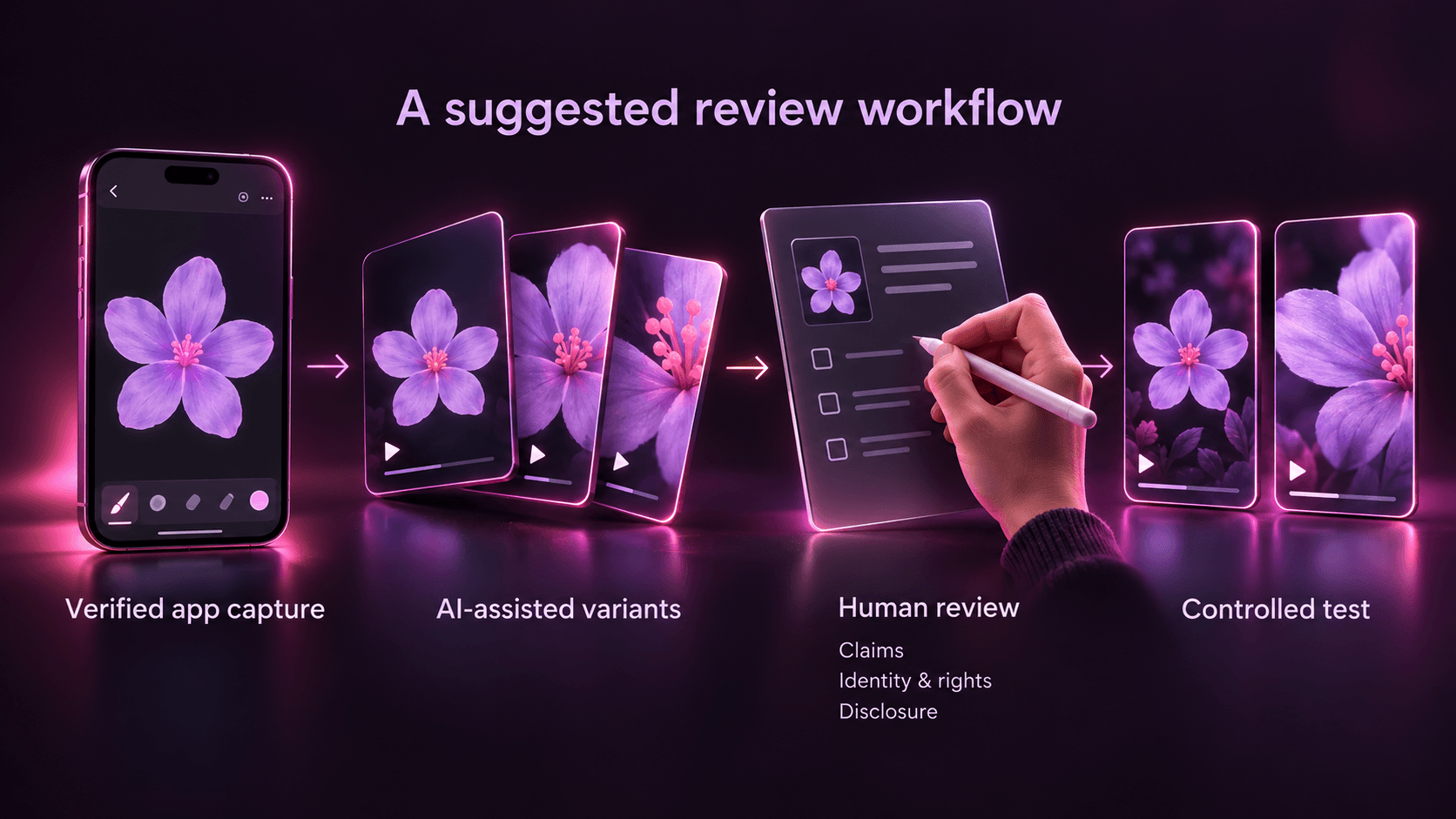
A practical release record can be short:
- Product owner: confirms the demonstrated feature, offer, and conditions against current approved material.
- Creative reviewer: compares the final image, audio, captions, and translations with the supported message.
- Rights and policy reviewer: checks the people, voices, source assets, tool terms, and disclosure requirements for the intended use.
- Launch owner: confirms that the approved file and destination are the versions being placed into the campaign.
- Escalation owner: can stop affected ads and coordinate corrections if a credible concern appears after launch.
These are responsibilities, not necessarily five different employees. A smaller team can combine roles, provided nobody treats an earlier approval as permission for every later alteration. An edited voice, stronger claim, different market, or changed offer can justify another review.
Protect the material used to create the ad too. Use approved tools and access-controlled workspaces. Prefer demonstration accounts and non-personal sample data over real customer screens or messages. Check authorization before uploading someone's photo or voice, and retain only the source material and permissions needed for the work.
Accountability should be shared clearly between client and partner. FTC guidance notes that an advertising agency may also be responsible for misleading claims and should independently check the information used to support them. Client approval is not a substitute for that work. FTC guidance for advertising agencies.
Choose a partner who can explain what was approved
When evaluating a paid-social partner, ask to see an example of the review process, with any confidential information removed. Can the team show where a claim came from, what AI changed, who authorized the likeness or testimonial, and which final version was approved?
Ask what would happen if a creator withdrew permission, the app changed, or users reported that the ad showed something unavailable. A useful answer names the owner, the affected assets, and the correction process. It does not depend on waiting for a platform to reject the ad.
After launch, evaluate acquisition quality alongside signs of confusion or misleading expectations. Comments and support feedback can reveal a question worth checking; they do not, by themselves, establish how widespread it is. A lower reported install cost is not a reason to keep an inaccurate ad running.
AI-assisted production can be valuable. The stronger partner is the one that can connect faster output to verified product facts, appropriate permissions, and a review decision someone is prepared to stand behind.
Sources checked on 12 October 2026. This article provides general information, not legal advice; policies and requirements can change.