A campaign can pass a fraud check and still bring very little useful growth. Real people can tap an ad by accident, misunderstand the offer, encounter a broken journey, or install an app they never use again. Blocking bots matters. It does not answer whether the advertising is attracting the right people for the right reasons.
For an app business evaluating a paid-social partner, traffic quality should therefore mean more than a low rejection rate. It should connect valid engagement with an honest product promise, a working route into the app, and an outcome the business actually values.
The distinction matters when results weaken. Calling every poor conversion rate “fraud” can send the team toward the wrong fix. Calling every accepted install “quality” can hide a campaign that is buying activity rather than customers.
Separate four questions that are often collapsed into one
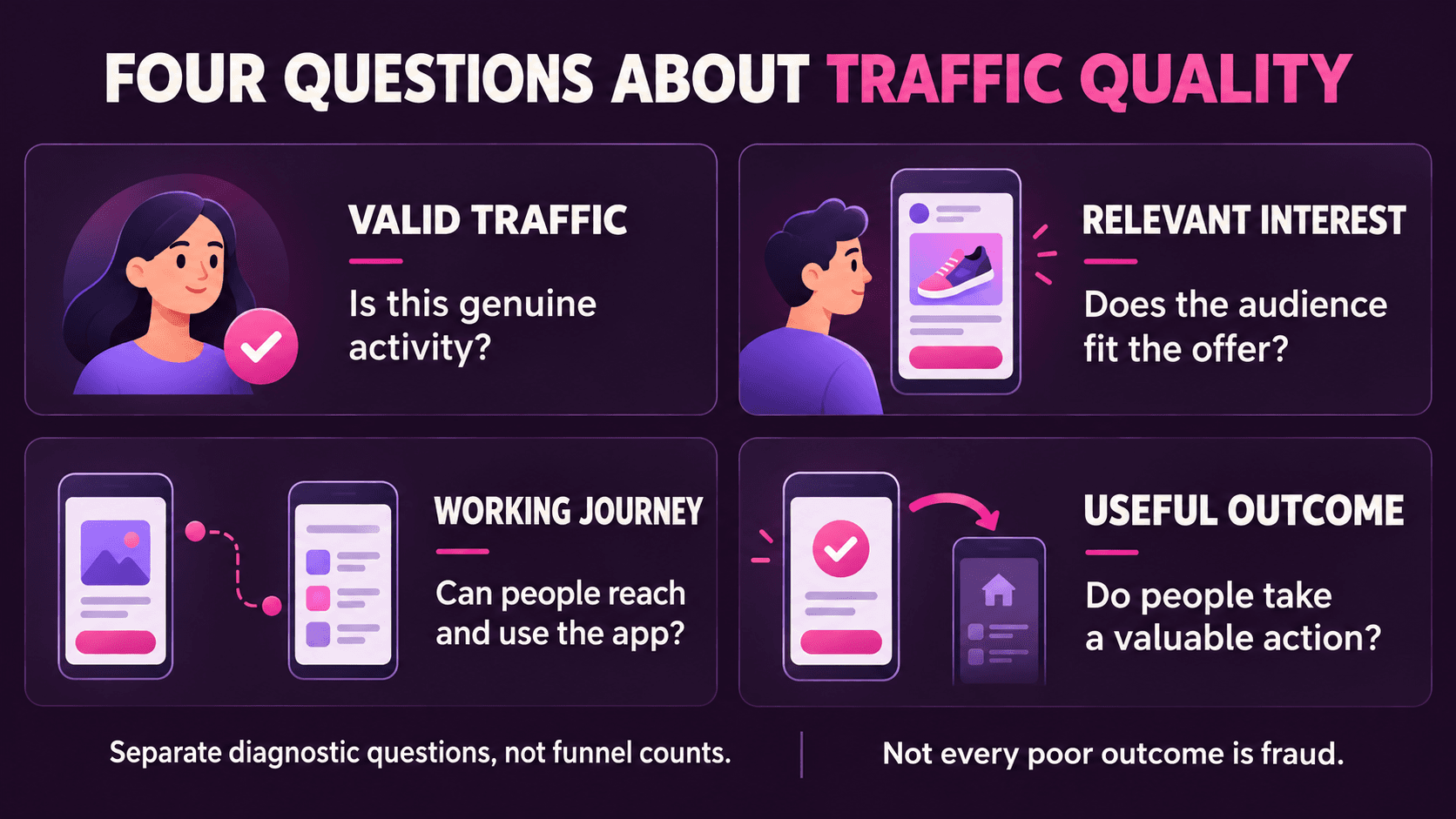
A useful traffic-quality review asks four separate questions. They are diagnostic lenses, not four mutually exclusive buckets of users or a score to average into one number.
- Validity: Is the engagement and attribution supported by legitimate activity, or is there evidence of fabrication, manipulation, or an eligibility-rule failure?
- Relevance: Does the person understand the offer and have a plausible reason to want this app? A real person’s click is not automatically evidence of that fit.
- Journey: Can an interested person reach the intended destination and complete the next step in the actual device and browser context?
- Value: After enough time, do the acquired users complete a meaningful action and continue receiving value from the app?
A weakness in one area does not identify the cause in another. Poor retention does not prove bot traffic. A clean fraud report does not prove an ad sets accurate expectations. Strong activation does not, by itself, prove the campaign deserves credit for those users.
A real customer can still be assigned to the wrong source
Fraud is not limited to invented people or fake devices. Adjust distinguishes device-level rejections from engagement fraud, where a real person downloads an app but the claimed ad engagement occurred without their knowledge. Click spam and click injection are examples of that second category. Adjust’s device and engagement fraud documentation
This is why downstream activity cannot be your only fraud check. A real customer may use and pay for the app while a manipulated attribution path claims credit for acquiring them. Conversely, an honestly acquired user may never become a customer.
Ask the measurement owner what was rejected, at which stage, under which rule, and with what evidence. Keep an automated fraud finding separate from a business-defined eligibility rejection. If the available evidence supports only an anomaly, label it an anomaly rather than declaring a source fraudulent.
AppsFlyer’s Protect360 raw reports include both fraud-engine findings and manually configured validation-rule results, with block reasons. They also distinguish real-time blocks from fraud identified after attribution. The presence of a record in a rejection report is a reason to read its classification, not skip that step. AppsFlyer’s Protect360 report documentation
Treat a suspicious pattern as a question to investigate
An unusual click-to-install delay, a sudden surge in repeated activity, or a sharp decline in downstream engagement can justify investigation. None is a universal verdict on its own. The useful next question is whether the pattern survives checks for measurement changes, delivery mix, and a broken user journey.
Adjust explicitly notes that non-fraudulent traffic can be flagged as a distribution outlier. Its guidance recommends checking for technical problems that delay or obstruct the journey and notes that ad design can also drive high click-through rates with low conversion. That is a reason to investigate the cause, not automatically turn off protection. Adjust’s Distribution Modeling guidance
For example, imagine a campaign whose recorded clicks rise while completed installs fall. A source-quality problem is one possibility. So are an unintended destination, a slower page, an unsupported device experience, or a reporting change. Establish which explanation has evidence before deciding what to block or replace.
Keep the claim narrow: “This segment shows an unexplained change in click-to-install timing” is defensible when that is what you observed. “These users are bots” requires different evidence. Avoid treating a device model, browser, country, or network characteristic as proof of fraud by itself.
Check whether the click represents informed interest
A useful ad helps someone decide whether the app fits their needs. An ad optimized only to provoke a tap can attract people who would have declined if the important conditions were clear.
Review the promise in the creative and the first destination together. Is the main feature actually available? Does a payment or subscription condition appear before it becomes a surprise? Is the demonstrated result representative of what the app does? A narrower, accurate promise may produce fewer clicks and better-qualified interest; that is a hypothesis to test, not a guaranteed result.
Use comments and support feedback to identify possible misunderstandings. Repeated questions about a paid feature being free can be a useful lead. They do not establish the prevalence of confusion across everyone who saw the ad.
Keep intent separate from page activity. A longer session or an extra button tap can indicate interest, but it can also reflect friction. Choose evidence tied to the user’s task rather than adding interactions just to make a report look healthier.
Do not blame the audience for a broken route
For campaigns that use a web landing page before the app store, a click and a loaded page are different observations. TikTok defines Landing Page View as an ad click followed by successful page loading while the person remains in session. It also warns that its LPV, third-party page views, and sessions can differ because their definitions and firing logic differ. TikTok’s Landing Page View guide
That definition is for the supported website-traffic context. It does not establish that an app installed, or make every page-view event in every analytics tool interchangeable. For a direct-to-store campaign, assess the handoffs you can actually observe rather than inventing a web-page checkpoint.
Have the responsible team review the real destination journey using an authorized test method. Check the intended app and store, supported market and operating system, and whether an in-app browser can complete the handoff. Separate a verified loading failure from a missing measurement signal.
The marketing partner can document the affected route and coordinate with the app or measurement owner. It does not need unrestricted production access, and it should not promise to fix parts of the app it does not control.
Write a quality verdict that leads to the right action
A practical review should end with a finding, the evidence behind it, an owner, and the next decision. Use different responses for different problems:
- Supported invalid activity: preserve the relevant evidence, identify the affected scope, and use the platform or measurement provider’s supported review and protection process.
- Genuine but poorly matched interest: review the promise and audience fit. Test a clearer message or more relevant proposition rather than merely demanding more clicks.
- Journey failure: give the destination owner a reproducible description of the broken handoff. Verify the repair before interpreting a new conversion rate.
- Weak customer outcomes: compare users with the same observation time and relevant context. Ask whether the issue concerns acquisition fit, onboarding, or the product experience.
- Insufficient evidence: record what is unavailable, who can obtain it, and when the decision can reasonably be revisited. Do not turn missing data into either a clean bill of health or an accusation.
For business outcomes, agree a meaningful action before reviewing the campaign. It might be completing a first useful task, returning for another session, or becoming a paying customer. Use the same event definition and cohort age when comparing groups; a day-old group cannot answer the same retention question as a week-old one.
Record the fraud report’s extraction time as well. AppsFlyer documents that the post-attribution report for installs in a given calendar month continues updating through the seventh day of the following month. That specific window should not be applied to every provider, but it shows why a same-day snapshot is not always a final classification. AppsFlyer’s post-attribution reporting guidance
What clients should expect from a growth partner
Ask for a quality explanation that connects the ad promise, the observed journey, the measurement limitations, and the customer outcome. A partner should be able to distinguish what it has verified from what it suspects, and name the team responsible for the next check.
That explanation should not require exposing individual customer records in a shared campaign report. Use aggregated evidence where it answers the question, and keep any necessary record-level investigation limited to authorized people and systems.
The goal is not to maximize the number of blocked clicks or minimize every rejection at any cost. It is to avoid paying for unsupported credit, reduce misleading or irrelevant engagement, and give genuinely interested people a fair opportunity to become useful customers.
Bot filtering belongs in that work. Traffic quality is the larger question: are the people, the promise, the journey, and the results all consistent with the growth you meant to buy?
Primary platform documentation checked on 14 October 2026. Examples are illustrative; no client campaign results or universal fraud thresholds are presented.