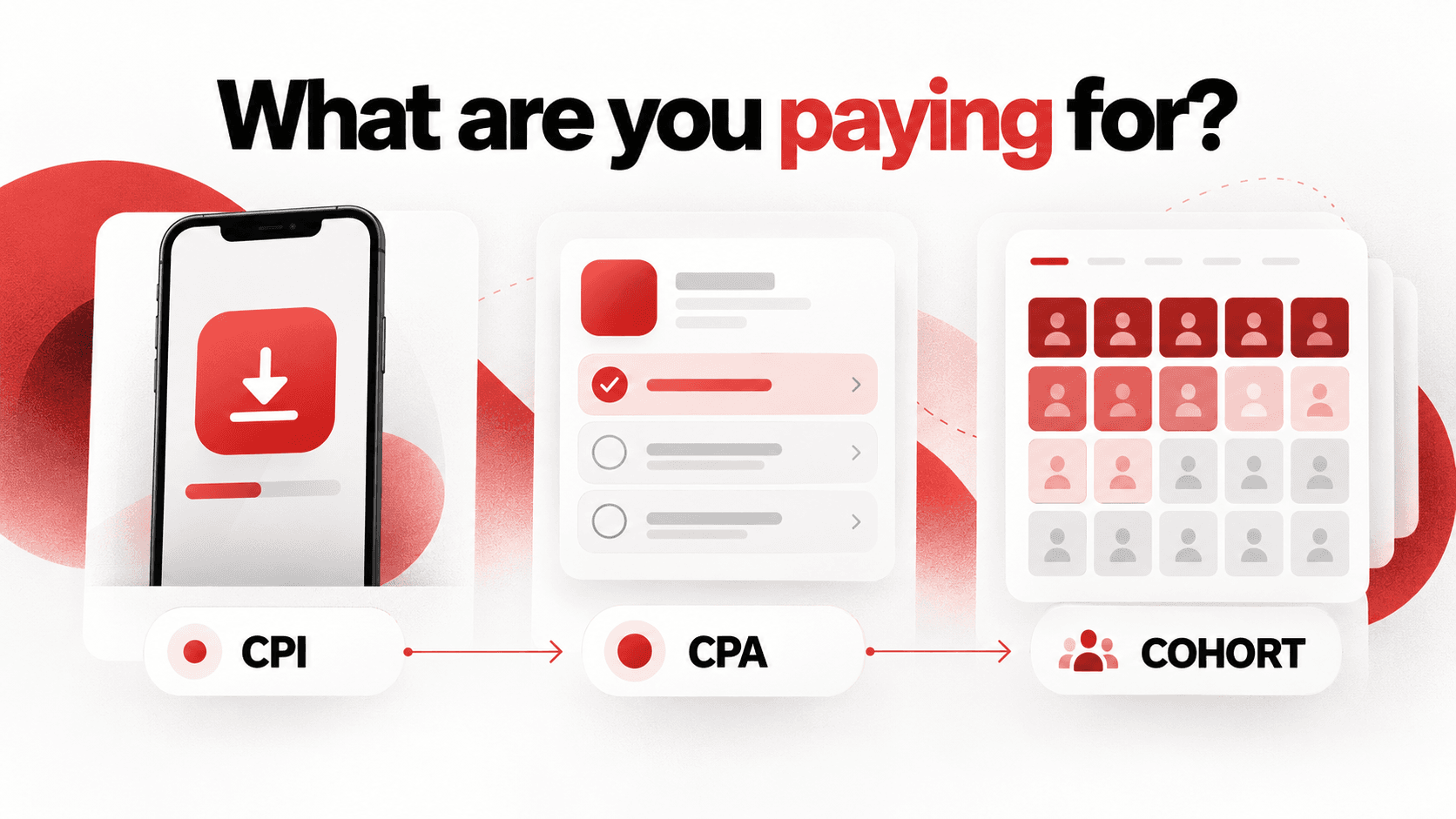
An app advertiser can buy a large number of installs and still struggle to find valuable customers. A growth partner can deliver the agreed action and still disagree with the advertiser about what should be paid. Both problems often begin with an outcome that sounded clear in a proposal but was never defined well enough to measure.
CPI, CPA and cohort-linked compensation each place the payment decision at a different point in the customer journey. The useful question is which point the advertiser can measure reliably, which risks each party can influence, and how quickly both sides can learn. There is no universally best model.
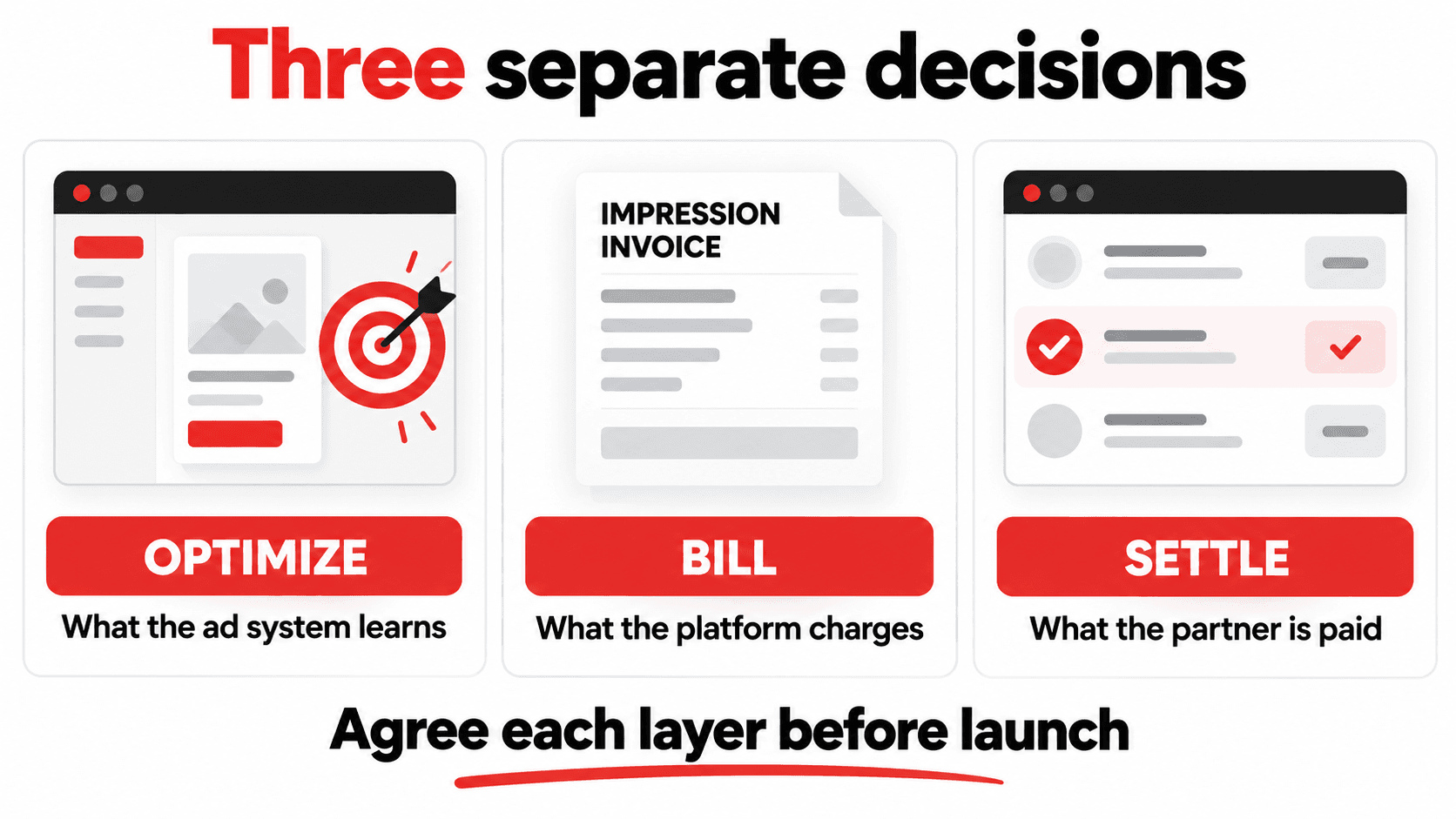
Separate optimization, media billing and partner payment
Start with three decisions that are often blended together. The optimization event tells an ad system what to seek. The billing event determines how the platform charges for delivery. The commercial agreement determines what the advertiser owes its growth partner.
Those decisions can differ. TikTok lists optimized CPM as a bidding method used for conversions and app installs, with impressions as the billing event. A campaign aiming for a target cost per action therefore does not necessarily charge only when an action happens. A separate CPA agreement with a partner does not change the platform invoice. [3]
Write down whether the quoted partner payout includes media costs, a service fee, or both. If the advertiser pays media separately, adding a partner fee to a reported platform CPA may be necessary to understand the full acquisition cost. If media is included, adding it again would double-count the same expense.
CPI: an early, observable outcome with downstream risk
Cost per install can describe an install-based price or a calculated metric: spend divided by attributed installs. In a CPI partner agreement, payment is tied to eligible installs under the agreed measurement rules. That does not establish whether those users will activate, return or generate revenue. [1]
This model can be practical when installs are measured dependably and downstream signals are too sparse or slow for an immediate commercial decision. The advertiser retains much of the risk that an eligible install produces little later value. The partner has a reason to find installs efficiently, so quality safeguards need to sit beside the volume target.
Define first installs versus reinstalls, geography and platform eligibility, attribution windows, duplicate handling and invalid-traffic treatment. Review activation and mature retention alongside CPI even when those measures do not determine the invoice. A low CPI is useful only in the context of what the acquired users do next.
CPA: choose an action that represents progress
Here, CPA means cost per action: a predefined event such as an eligible registration or first purchase. The term is also used for cost per acquisition, so the event should always be named rather than left behind an acronym. [2]
Moving the payable event further into the app journey can shift some conversion risk toward the partner. It also introduces dependencies the partner may not control: onboarding, eligibility decisions, outages, purchase flows and event instrumentation. An agreement that ignores these dependencies can reward or penalize the wrong behavior.
A registration is quick to observe, but may be weak evidence of lasting value. A purchase is closer to revenue, but may arrive later and be refunded. For a fintech app, a deposit should not be treated as revenue without an explicit accounting basis. For a rewards app, repeated low-value actions or reward redemptions should not automatically become evidence of profitable acquisition.
Choose the action with the app business, then define the qualifying conditions. Does “first purchase” mean one unique new customer, a minimum eligible amount and no cancellation within the agreed review period? How are repeat events, retries and account duplicates handled? The rules should be agreed before launch and available to both parties, not introduced after a campaign has spent its budget.
Cohort-linked payouts: closer to value, slower to settle
In this article, cohort-linked payout means a negotiated arrangement where compensation depends partly on the later performance of a defined group of acquired users. It is not a single standardized platform product. An agreement might combine an initial eligible-event payment with a later adjustment based on retained users or agreed revenue. These are design options, not BerryGood Media contract terms or industry benchmarks.
Specify the cohort entry event, acquisition dates, sources and included users. Define the observation period and whether revenue is cumulative through a day or earned on that day. AppsFlyer distinguishes complete and partial cohort data and cumulative from on-day measures. Compare equivalent cohort ages; a newly acquired group has not had the same opportunity to generate revenue as an older group. [4]
Also agree the revenue basis. AppsFlyer documents negative revenue events for refunds and cancellations, and notes that deductions such as VAT and store commissions must be reflected in what is reported rather than assumed to be calculated automatically. A revenue-linked contract needs its own explicit treatment of refunds, fees, taxes, currency conversion and late adjustments. [5]
This approach can align payment more closely with the advertiser’s business, but it delays certainty and cash collection. The app business must supply dependable downstream evidence. The partner needs a defined settlement date, a visible calculation and a bounded dispute process. Retention or revenue reported by an MMP is evidence for the agreement; it is not automatically an accounting profit calculation.
Compare models using the same economic question
Consider an illustration, not a benchmark or client result. Option A costs $2 for each of 1,000 eligible installs: $2,000 total. If 100 become qualifying customers, acquisition cost is $20 per qualifying customer. Option B costs $18 for each qualifying customer; 120 qualify, so total cost is $2,160 and acquisition cost is $18 per qualifying customer. The cheaper quoted unit in Option A does not produce the cheaper customer.
That comparison only holds if the customer definition, cohort age, traffic scope and included costs match. It does not show that Option B caused more incremental customers or that either group is profitable. Compare later contribution using the advertiser’s own agreed revenue and cost definitions. Reconcile total media invoices separately: AppsFlyer notes that costs without associated attribution can be absent from a cohort report. [4]
Keep platform metrics, commercial payable counts and accounting outcomes visible as separate totals. A discrepancy should have an explanation, such as a different window, a duplicate, a refund or an ineligible market. Do not silently force the reports to agree by removing costs or changing definitions.
Put a short measurement agreement beside the rate
- Outcome: name the payable event, qualifying conditions, unique-user rule and eligible campaign scope.
- Evidence: identify the source of truth, required event fields, attribution settings and how both sides can inspect a disputed count without exposing unnecessary personal data.
- Timing: define cohort entry, timezone, maturity, reporting lag, settlement date and the final adjustment window.
- Economics: state whether media and service fees are included, and define revenue, refunds, taxes, currency and other deductions.
- Quality: specify invalid-activity evidence, review ownership and dispute handling. Separate blocked activity from fraud detected after attribution. AppsFlyer documents both categories; neither should be treated as an infallible verdict without the relevant evidence. [6]
- Change control: record who can change event mappings, eligibility rules or the app journey. Agree how an outage or instrumentation change affects reporting and settlement before it happens.
Choose the model your evidence can support
Use CPI when an early measurable outcome is the practical starting point, with downstream quality reviewed separately. Use CPA when a meaningful action can be defined, observed and reconciled. Consider cohort-linked terms when both parties can wait for mature evidence and agree on how later value changes payment.
A bounded pilot can test the event definitions and reconciliation process before either side commits to greater volume. Its length and exposure should follow the expected outcome delay and the advertiser’s tolerance for uncertainty, rather than a universal number of days or installs.
For an app advertiser evaluating a growth partner, the strongest proposal makes the payment logic easy to inspect. It explains what is bought, what remains uncertain, which party owns each dependency and how a disputed result will be resolved. The rate matters. So does the evidence that makes it payable.
Sources checked October 23, 2026. Recommendations are editorial synthesis; the numerical example is illustrative, not a benchmark or client result.
TikTok: Available bidding methods
AppsFlyer: Cohort and retention dashboard