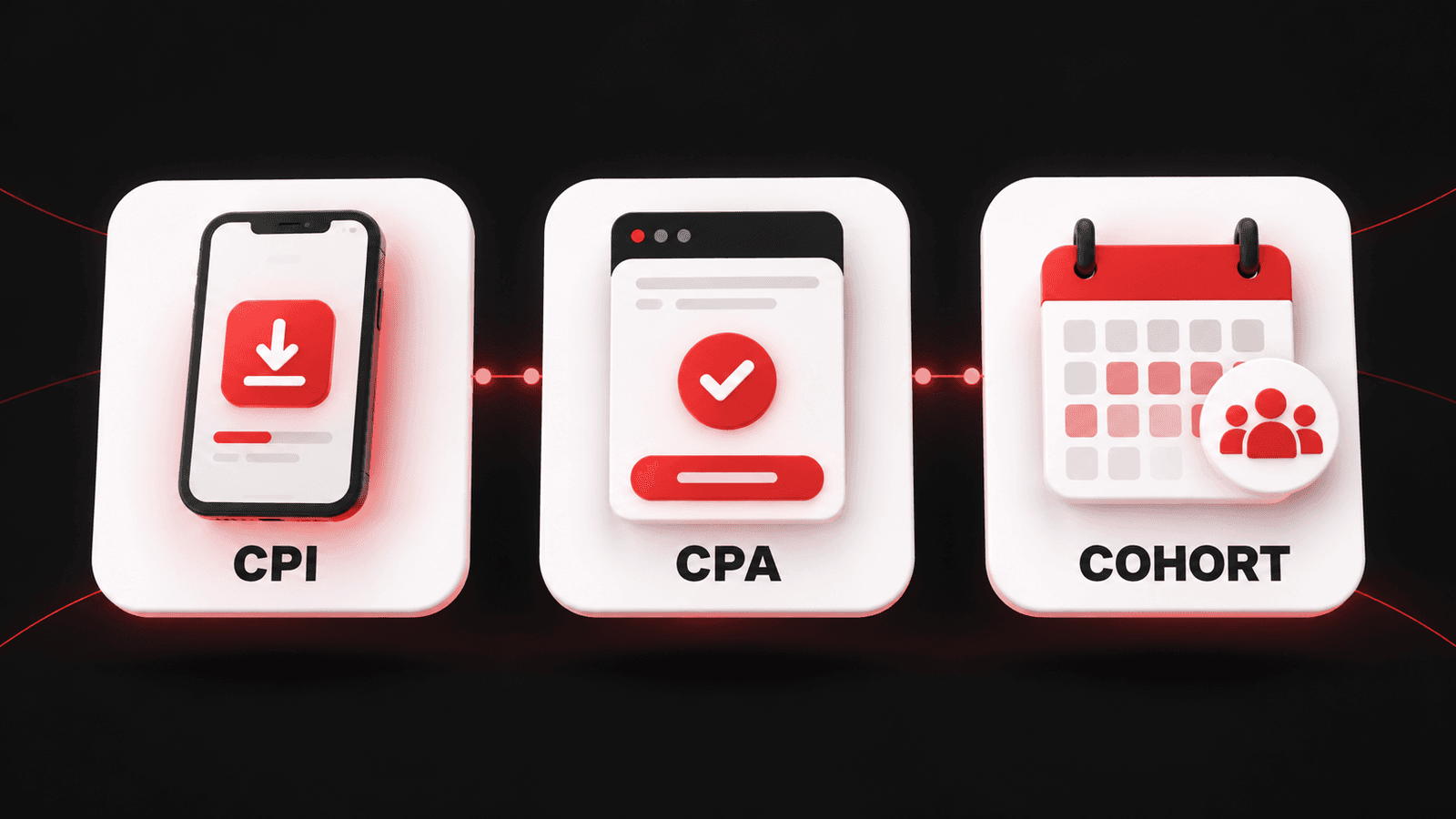
The holiday calendar creates urgency. It does not tell you whether the next customer will be worth acquiring.
As November 2026 begins, an app business can make a reasonable case for advertising now, testing selectively, or holding back. The mistake is choosing from a slogan: “Everyone is shopping,” “Q4 is too expensive,” or “January will be cheaper.” None answers the question that matters: does this app have a credible reason to acquire this audience in this market at this moment?
For the US calendar, Thanksgiving falls on November 26, Black Friday on November 27, and Cyber Monday on November 30, 2026. Those dates give your team a planning deadline, not a reason to spend. US holiday calendar · Black Friday and Cyber Monday dates
Start with your customer’s reason to act. Then check whether the economics, measurement and operating team can support it. Your plan may differ across countries, products and acquisition goals.
The holiday rush is not one market
Recent historical data is useful, but its boundaries matter. AppsFlyer’s October 2026 e-commerce-focused holiday playbook analyzes 165 million installs and 210 million in-app purchases across eight markets during a five-week period in 2025. Its date-specific lifts are measured against each market’s average day within that same window, not against the previous year. In the UK, Black Friday purchases rose more sharply than installs; in the US, the two moved much more closely together. Those observations describe a particular dataset and period. They are not a forecast of your app’s 2026 acquisition cost. AppsFlyer’s 2026 holiday playbook
There are different calendars outside shopping, too. Adjust’s retrospective of the 2025/2026 festive period reports entertainment and gaming installation strength after Christmas, while finance sessions were stronger earlier in December and dipped during the festive break while remaining above the report’s annual average. These are activity patterns, not evidence that a paid campaign in every category became more profitable. Adjust’s festive-season app trends
The practical question is narrower than “Does Q4 work?” Ask what changes for your customer. Does a shopping app have a genuine, relevant offer? Does a utility solve a task people need now? Does a finance or rewards app have a useful proposition beyond a seasonal visual? These are hypotheses to test, not category forecasts.
Do not borrow retail urgency if the product does not deliver it. A calendar-themed ad can get attention while acquiring people whose needs do not match the app.
Decide what waiting would actually improve
Waiting can protect a budget. It can also postpone the same unresolved problem.
Write down what will be different at the later launch date. Perhaps the app team will have fixed onboarding, approved new creative, completed measurement checks, or assembled a more relevant offer. Those are concrete reasons to wait. “The auction should calm down” is a scenario, not a plan.
Conversely, advertising now can be justified when the use case is time-sensitive, the existing acquisition program has credible economics, and the team can respond during the period. It is not necessary to turn every functioning campaign off simply because a holiday is approaching.
Separate the decision about existing activity from the decision about extra spend. Maintaining a proven campaign, launching into a new market, and multiplying a budget are three different commitments. A business may reasonably continue the first while declining the other two.
January is not a guaranteed discount window. Your audience, product demand, conversion rate and customer value may change alongside media prices. A cheaper impression is only useful if it reaches someone who is likely to become a worthwhile customer.
Compare the right customers, not just the media price
A holiday dashboard can make both optimism and pessimism look convincing. Rising cost per thousand impressions (CPM) may coexist with stronger purchase intent. A falling cost per install (CPI) may coexist with weak activation. Neither media metric settles the budget decision alone.
Use the business outcome that matches the app: a qualified activated user, first-time payer, retained subscriber or another clearly defined event. Keep the definition fixed across the comparison. An app that counts first purchases in one period and all purchases in another has changed the question.
Then compare cohorts—groups of users acquired in the same period—at the same age. A recent holiday cohort has not yet had the same opportunity to renew, refund or generate revenue as an older one. Show what is observed so far separately from any projection. Payback means recovering acquisition spend from the customer value available after relevant costs, not merely reaching a gross revenue target. AppsFlyer explicitly distinguishes partial and completed cohort periods; check the report’s time convention before comparing systems. AppsFlyer’s cohort documentation
For a seasonal offer, also ask whether the incentive changes the customer mix. Does the acquired group return after the promotion? Does an introductory subscription price convert into durable value? The answers belong in the acquisition assessment, not in a footnote below a low CPI.
Set the affordable downside before adding spend. Include the business’s actual revenue deductions, variable costs and cash timing rather than treating gross return on ad spend (ROAS)—reported revenue divided by ad spend—as spendable cash.
Give the campaign enough runway to answer its question
A last-minute launch can leave little room between approval, delivery, conversion and a useful decision. Work backward from the decision date rather than starting with the day you want ads live.
Allow time for creative review, destination checks, measurement validation, campaign delivery and the conversion delay relevant to the app. A trial that charges later cannot provide mature payer economics on launch day. Platform stabilization and business-outcome maturity are different clocks.
As one platform-specific example, TikTok’s learning-phase guidance describes performance fluctuation during learning and identifies changes that can affect that process. It does not make learning status a substitute for your own financial boundary or a reason to ignore a broken destination. TikTok’s learning-phase guidance
Build your runway around the campaign, review process and customer journey. If the remaining time cannot answer the intended question, narrow the question or defer it.
For an existing campaign, record material changes during the period. A new offer, a new audience and a new creative direction introduced together will make it difficult to explain what caused the result.
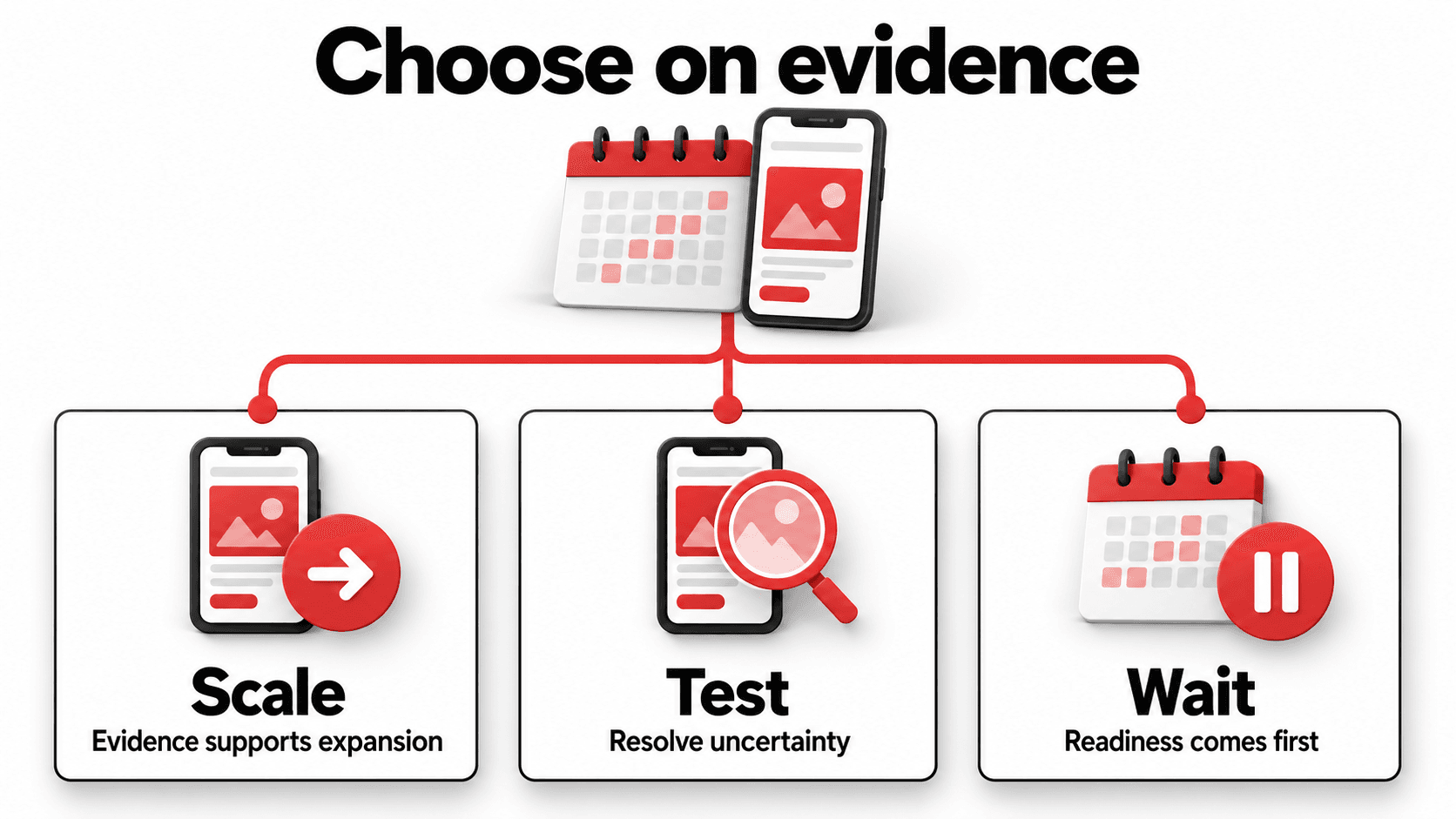
Choose scale, test or wait—by campaign, not by season
Keep proven activity separate, then use three decisions for additional commitments rather than an all-or-nothing holiday bet.
- Scale selectively when there is a relevant seasonal use case, credible customer-value evidence, working measurement and enough creative and operating capacity. Set the limit on additional exposure and decide when the next customer group will be evaluated. A strong historical average does not promise that additional volume will perform the same way.
- Test when the opportunity is plausible but an important assumption remains unresolved. Name the assumption: perhaps a seasonal message attracts better-qualified users, or a particular market responds to the offer. Choose a budget and design capable of informing that decision. If the affordable test cannot do so, do not call a handful of outcomes proof.
- Wait when the customer proposition is weak, critical measurement is unreliable, the destination is not ready, or the team cannot support the campaign. Assign the missing work and a decision date. Waiting should produce readiness, not merely a later calendar entry.
Apply these decisions to a named audience, market, offer and objective. You can maintain one campaign while testing another and postponing a third.
A hypothetical bounded-test memo
Consider a fictional utility app testing one seasonal message in one market. The figures below are invented planning choices, not benchmarks or a recommended minimum budget.
“Run a seven-day acquisition test with a total media-spend ceiling of $1,500, including any comparison allocation. The campaign owner will verify the available spending controls before launch, allow for delivery and shutdown delay, and initiate shutdown early enough to stay within the ceiling and the acquisition window. Stop sooner if activation tracking breaks or the destination fails.
“Count a qualified activation only when a new user completes the app’s core task. Evaluate each acquired group after 14 completed days, using the same cohort-age definition as the baseline. Record cost per qualified activation and the share that repeats the core task by day 14. Do not compare day-two holiday users with day-14 historical users.
“Stop spending while outcomes mature; the last acquired group still needs 14 completed days after acquisition before the full evaluation. Further spend needs a separate decision against the app’s pre-agreed acquisition-cost and repeat-use criteria. If the sample or tracking cannot support that decision, label the result inconclusive rather than extend the test automatically.”
This tests a near-term activation hypothesis, not lifetime profitability. A historical comparison also does not isolate the message’s causal effect; use a properly designed controlled comparison when that is the decision you need. The useful discipline is the fixed exposure, equal-age evaluation and explicit next decision—not copying the example’s numbers.
Check the capacity behind the creative
Holiday creative is more than changing a background or adding a countdown. The ad, store page and app experience need to make the same truthful promise. If the offer ends, the campaign needs an owner who can remove or replace the message. If a promotion has eligibility conditions, those conditions need to be represented clearly rather than left to an unpleasant discovery after install.
Before committing extra spend, check what the team can actually maintain: approved concepts, usable variations, review coverage, destination ownership and a response plan for faults. Make the responsibilities explicit: the acquisition partner can help plan and evaluate the campaign, while the app business remains responsible for the product experience and the offer it can honor.
For example, TikTok recommends maintaining a creative library and responding to sustained delivery deterioration; this is guidance to monitor and prepare, not a universal expiry date for an ad. TikTok’s creative guidance
Plan replacement work around performance evidence and production lead time, not a fixed expiry date. An overloaded team with one fragile concept may be less ready to scale than a campaign dashboard suggests.
Make the November decision easy to revisit
Put the decision in a short memo before the next spend change:
- Scope: which app, market, audience, offer and acquisition objective this decision covers.
- Seasonal reason: what customer need changes now, and the evidence or hypothesis supporting it.
- Baseline: which historical period is comparable, and what has changed since then.
- Commitment: continue, scale, test or wait; the authorized exposure and the person who controls it.
- Evidence: the primary business outcome, cohort age and reporting delay used for the decision.
- Readiness: creative, measurement, destination and response owners.
- Review: when to reassess, what would stop additional spending, and what would justify a new commitment.
Keep historical benchmarks in their proper role. Match geography, category, acquisition source, operating system and objective where possible; explain the gaps where not. A vendor-wide holiday trend can suggest a question worth asking. It cannot supply your app’s answer.
The best choice is not necessarily to buy through the rush or sit it out. It is to know which part of the opportunity you are prepared to fund, what evidence would change your mind, and what waiting would accomplish. Make that decision now, before the calendar makes it for you.