An app campaign is spending less than planned. One person proposes a higher bid cap. Another wants a lower cost-per-result goal. A third suggests adding a ROAS goal. Those changes address different things, and they do not all make delivery easier.
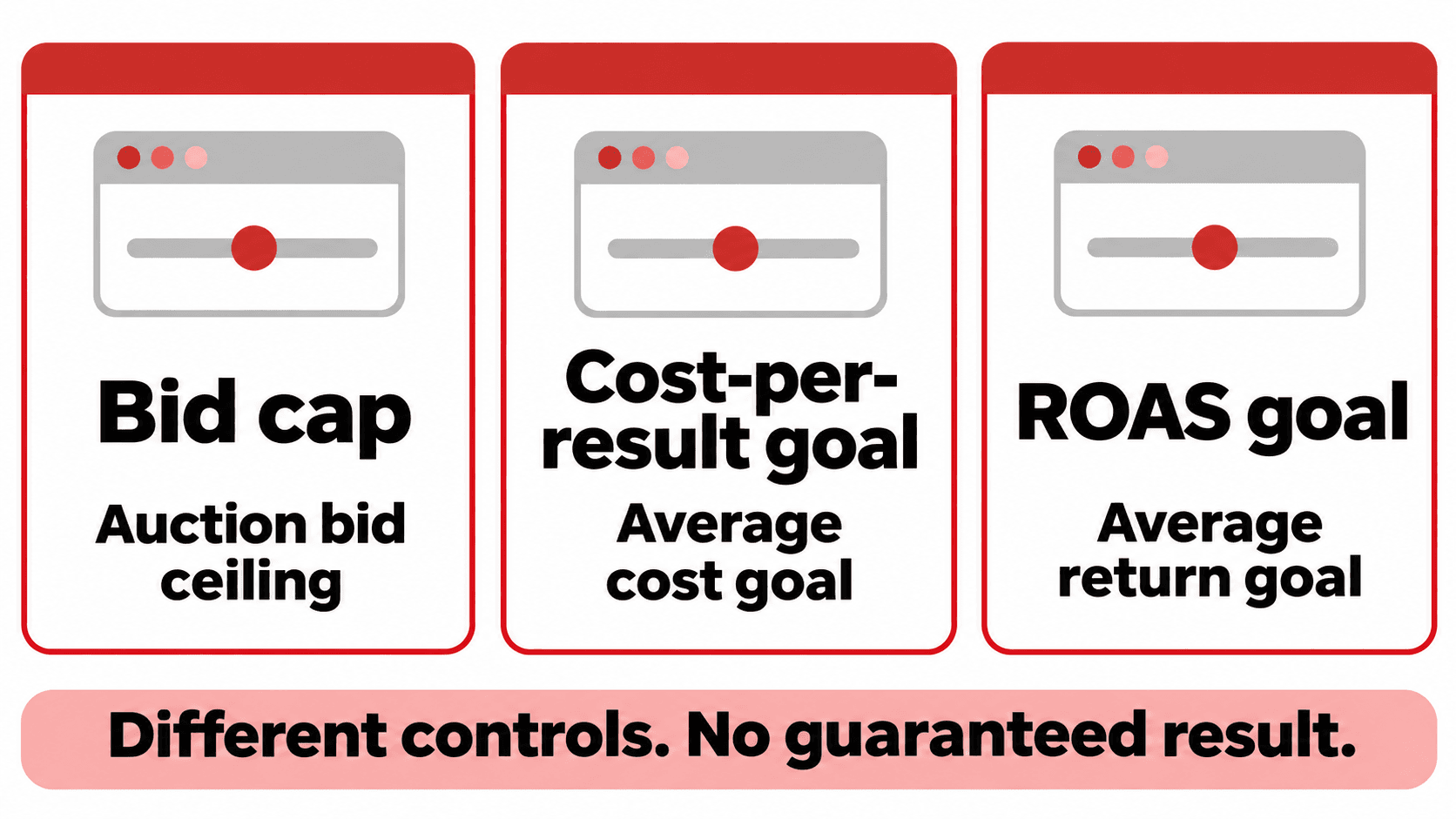
The first task is to identify what the current setting controls. A maximum auction bid, an average cost goal and an average return goal are different instructions to Meta. None promises a particular number of new customers or a profitable campaign.
This guide uses Meta's public documentation checked on November 11, 2026. It explains the documented behavior, then offers a practical review process. Available controls depend on the objective, performance goal, event, app platform and account. Check the actual setup rather than assuming every option below can be selected together.
Bid cap: control the auction bid
Meta describes bid cap as a maximum bid per estimated action in an auction. The word estimated matters: the system predicts whether someone will complete the action. That prediction and the results later recorded in reporting are not the same thing. [1][2]
A bid cap therefore does not impose a maximum reported cost per install, registration or purchase. It is also not a campaign spending limit. Setting a cap equal to the business's acceptable acquisition cost does not establish that the eventual CPA will stay below that amount.
This gives an experienced advertiser direct control over bidding, with more responsibility for understanding how the cap translates into delivery and reported costs. Meta positions bid cap for advertisers who can make those decisions. A restrictive cap can limit available delivery; raising it permits higher bids but does not guarantee more valuable customers. [1][2]
Use it when there is a specific reason to control auction bids and the team can evaluate the consequences. Do not choose it merely because the word cap sounds like a guarantee about the final cost of each customer.
Cost-per-result goal: guide average result cost
With a cost-per-result goal, Meta adjusts bids to seek conversion volume around the chosen average cost. Its documentation says Meta aims to keep weekly average cost near the goal over the campaign's lifetime. Actual average cost can be above or below the goal. [3]
The goal is not a price ceiling on each individual conversion. Results may arrive unevenly, and a short reporting window can differ from the average the strategy is pursuing. Meta recommends evaluating this strategy over a week rather than judging it from a single day. [3]
The delivery tradeoff is deliberate. If the goal is difficult to achieve, Meta may leave budget unspent rather than pursue more volume at any cost. Lowering the goal asks for greater cost efficiency; it should not be treated as a way to unlock more delivery. [1][3]
For an app advertiser, the next question is what counts as the result. A target for an install and a target for a purchase describe different outcomes. For example, an app campaign could meet its install-cost goal while few of those users start a trial or complete the first useful task. The install result would meet the goal, but the business would still need to investigate the weak downstream outcome. This is an illustrative scenario, not a measured result.
ROAS goal: guide conversion value relative to spend
ROAS means return on ad spend: reported conversion value divided by advertising spend. A ROAS goal belongs to value optimization, using the performance goal Maximize value of conversions. Meta adjusts bids to maximize conversion value while aiming to keep weekly average ROAS near the goal over the campaign's lifetime. Actual average return can differ from the goal. [4]
If Meta cannot find enough opportunities consistent with that goal, delivery may slow and some budget may remain unspent. A more demanding ROAS goal can make delivery harder. Meta's highest-value strategy provides a useful contrast: it seeks value while prioritizing use of the budget, without the same specific ROAS goal. Neither promises profitability. [4]
For app promotion, value optimization is not limited to purchases. Meta's app-specific guidance describes purchase-value and in-app ad-impression-value optimization, subject to the relevant setup and eligibility. An ad-supported app should check the supported ad-revenue path and its eligibility. [5][6]
For iOS app value optimization, check the requirements for the selected event and whether the campaign uses Aggregated Event Measurement (AEM) or SKAdNetwork optimization. Their setup requirements differ. AEM and SKAdNetwork reporting can also differ, so keep the reporting view consistent when comparing results. [6][9]
The value being optimized still needs a clear definition. Platform-attributed revenue divided by ad spend is not automatically lifetime customer value, incremental return or profit after fees, refunds and operating costs. A ROAS goal in Ads Manager does not guarantee any of those business outcomes.
Choose the outcome before the control
Start with the action or value the campaign should pursue, then inspect the bidding choices available for that setup. The three controls above are alternatives with different requirements, not three safeguards to stack onto every campaign.
Consider three illustrative briefs:
- An install campaign: The immediate objective is installation volume, while downstream quality is reviewed separately. A cost-per-result goal, where available, concerns that selected result. It does not guarantee a later paid conversion.
- A purchase campaign: The business needs to decide whether to prioritize purchase count or purchase value. If orders vary in value, those are materially different instructions. Moving to value optimization changes the test, not just the number entered in a bidding field.
- An ad-supported app: The relevant value may be in-app advertising revenue. Confirm the supported event, operating system, integration and value-optimization eligibility before choosing a ROAS goal. Do not assume that a purchase-based setup and an ad-impression-based setup are interchangeable.
These are decision examples, not performance claims. The right choice depends on the app's economics and the quality of the signal available to Meta.
Check eligibility and the value signal
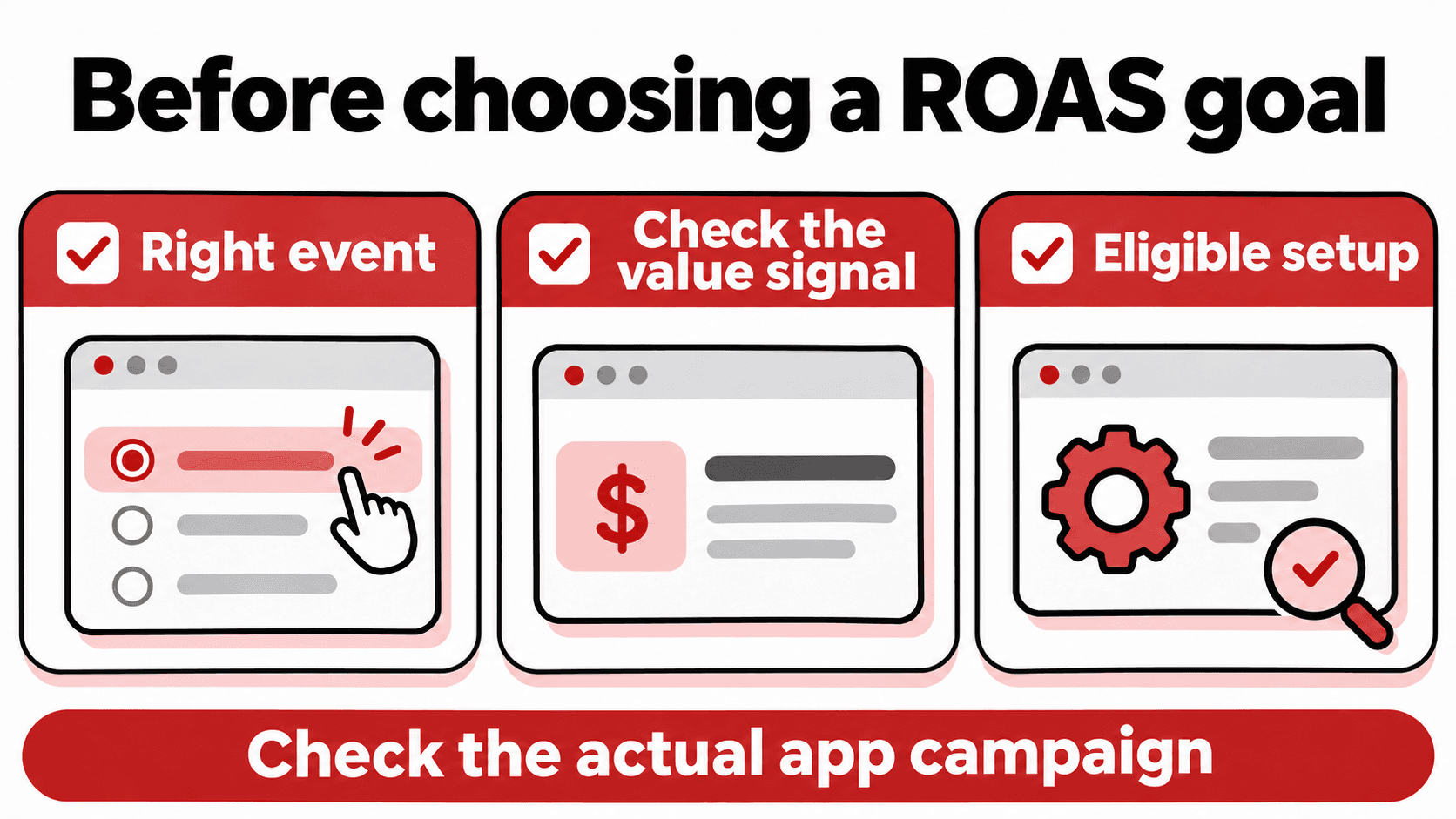
Before entering a goal, record the objective, performance goal, optimization event, operating system and attribution setting. Then check which controls the actual campaign type and budget setup expose, rather than copying another campaign's settings. Meta documents different routes for campaign budgets and ad-set budgets, so a screenshot from another setup is not enough to establish availability. [7]
For app value optimization, Meta identifies integration through its SDK, Conversions API or a mobile measurement partner, together with event-specific requirements. Revenue and currency need to be sent correctly. Its MMP guidance calls for the relevant events from all sources, not only those attributed to Meta. [6]
Ask the app or measurement owner to verify what is being sent. Does a purchase event carry the actual transaction value in the intended currency? Does an ad-impression event carry the supported revenue value? Are missing or duplicate events distorting the signal? Advertising settings cannot correct a value definition that is wrong upstream.
Check Meta's current app eligibility requirements rather than copying a numerical threshold from a general value-optimization guide. Requirements differ by event and setup. If Maximize value of conversions is unavailable or grayed out, resolve the eligibility question before describing the campaign as a ROAS-goal campaign. [6]
Read underspend as a question to investigate
Unused budget is not, by itself, proof that a bid strategy is broken. It may reflect a restrictive bid cap, an ambitious cost or return goal, or another delivery limitation. Review the selected control alongside ad eligibility, audience scope and event health before changing it.
The direction of the proposed change matters. A higher bid cap permits higher auction bids. A lower cost-per-result goal asks Meta to pursue a lower average result cost. A higher ROAS goal asks for more value relative to spend. These are not equivalent ways to increase volume.
Nor does increasing the budget necessarily remove a binding goal. Meta specifically warns that a restrictive ROAS goal can constrain delivery even when the budget rises. [8] If the wider issue is whether to change budget, reach or measurement, use our separate guide to finding the constraint before scaling app ad spend.
Define a fair comparison before changing settings
Write down one question the change should answer. For example: can this campaign obtain more qualified purchases within the approved acquisition economics if the selected control is relaxed? Then identify the metric that would show whether that happened.
Keep the event, creative, audience scope and attribution setting stable where practical. If moving from result-count optimization to value optimization is part of the change, say so explicitly. Comparing their headline CPA alone would overlook the different instruction given to the system.
Review spend, result count, average result cost and attributed value together. Use comparable reporting windows and allow for the relevant outcome and reporting delays. For app reporting, Meta notes that AEM and SKAdNetwork results can differ and that reporting can include statistical modeling. Do not silently swap measurement views between the baseline and the test. [9]
Separately inspect the business outcome at the agreed customer-value horizon. A low platform CPA is useful only if the acquired customers meet the quality and value requirements behind the brief. An attractive ROAS from very little delivery may also be insufficient evidence for a larger spending decision.
This comparison process is editorial guidance, not a universal test duration or a prediction of performance. Set the spending boundary, review owner and decision criteria before the change. A goal in Ads Manager does not replace those controls.
Make the setting understandable to the next reviewer
A short approval record can prevent a long argument later:
“This campaign optimizes for [event or value]. It uses [bid cap, cost-per-result goal or ROAS goal] at [setting], which controls [auction bids, average result cost or average return]. Availability and signal quality were checked for [app setup]. We will assess [outcomes] using [measurement view and window], within [approved spending boundary].”
If that sentence cannot be completed clearly, revisit the setup before changing spend. The useful distinction is simple: know what the control asks Meta to do, what it cannot promise, and which business evidence will decide whether it helped.
Sources and scope
Primary sources checked November 11, 2026. Meta's public Help Center documentation supports the platform descriptions above. No advertiser account interface was inspected for this article. Availability and labels should be verified in the actual campaign. Examples are illustrative and contain no client results or performance benchmarks.
1. Meta: About bid strategies.
3. Meta: About cost per result goal.
5. Meta: About maximizing value of conversions using the app promotion objective.
6. Meta: About eligibility requirements for maximizing value of conversions in app promotion campaigns.
7. Meta: About cost and bid controls.
8. Meta: Best practices for ROAS goal.
9. Meta: About reporting for app events sent through Aggregated Event Measurement.