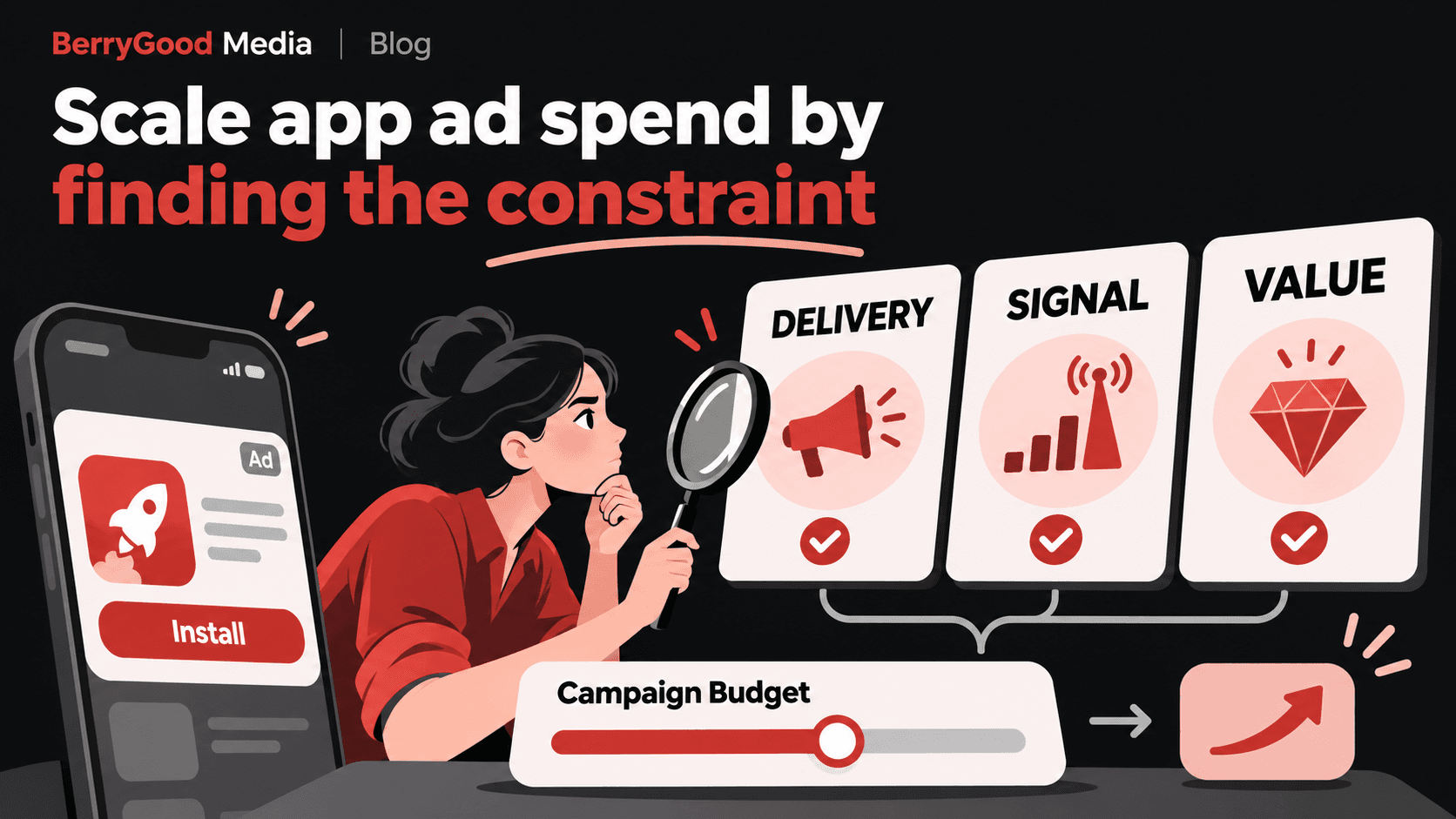
A campaign is meeting its acquisition target, and the team wants more volume. The obvious next move is to raise the budget. The useful first question is what is actually limiting delivery.
More budget can help a campaign that is constrained by its spending allowance. It cannot repair missing conversion events, an ad that no longer earns attention, or customers whose value does not support their acquisition cost. Scaling responsibly starts with separating those conditions.
This guide focuses on the operating decision after a campaign has shown promise: which lever to change, how to contain the downside, and what evidence should decide the next move. It is a review framework, not a promise that efficiency will stay constant as spend grows.
Identify the constraint before choosing the lever
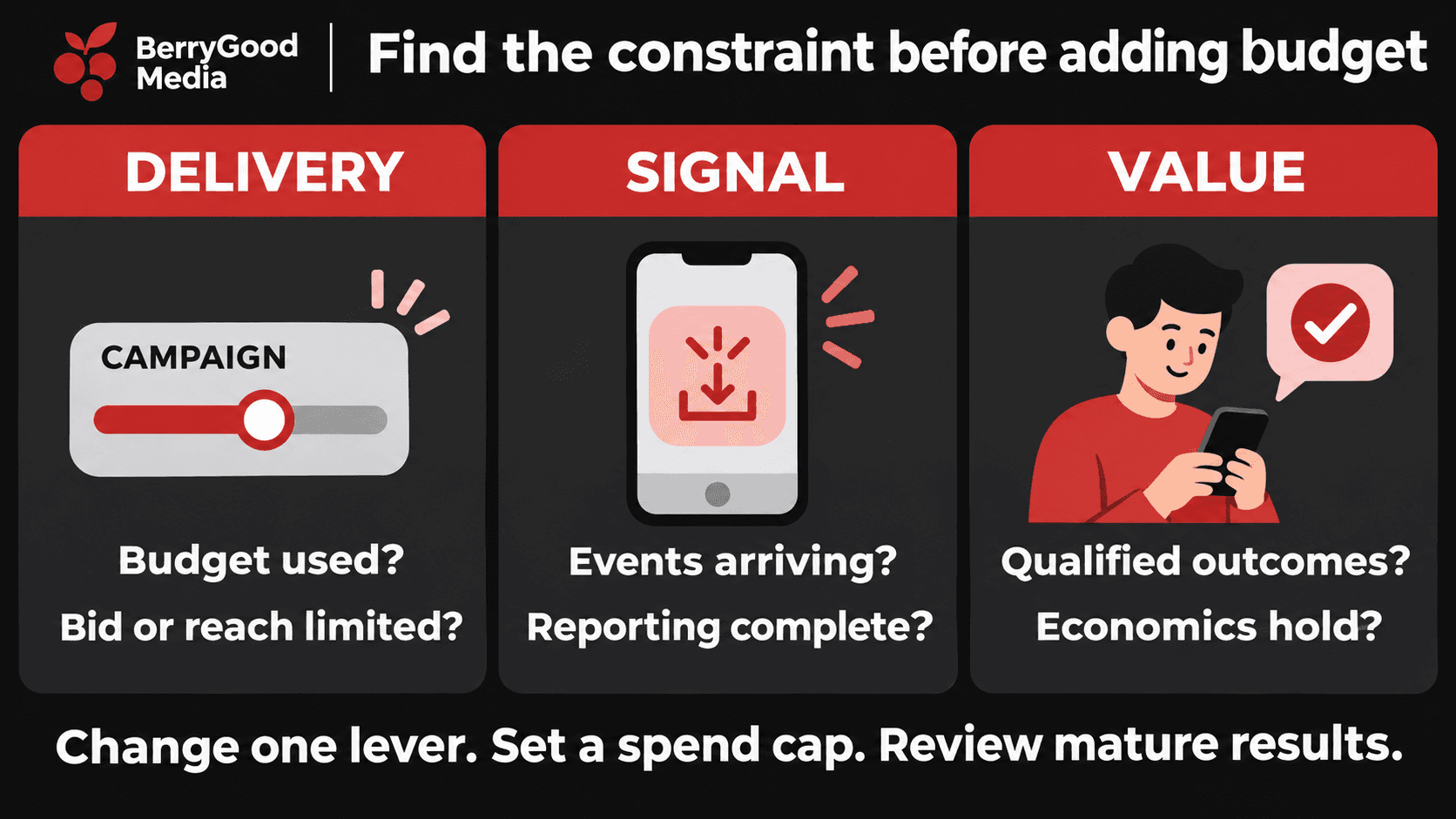
Start with actual spend against the available budget over comparable periods. Then inspect delivery status, bid strategy, audience restrictions, creative eligibility and event health. A campaign that consistently underspends needs a diagnosis before it needs a larger allowance.
Budget-constrained: delivery regularly uses the available allowance, qualified outcomes remain acceptable and no measurement or eligibility issue explains the result. A bounded budget increase may be worth testing.
Bid- or reach-constrained: the campaign has spending room but cannot find enough eligible opportunities under its current settings. Check the relevant cost control, audience, placements and ad status. Raising the budget alone may leave the underlying constraint unchanged.
Signal-constrained: qualified events arrive late, disappear or change definition. Confirm the app-to-MMP-to-platform path with the app team before asking an automated system to spend more against uncertain feedback.
Value-constrained: delivery is available but the acquired customers do not meet the business's agreed economics. More volume is not the immediate objective. Find out whether the cause is acquisition mix, the creative promise, product experience or the value assumption itself.
These categories can overlap. Record the strongest evidence for the diagnosis and the evidence that could disprove it. A platform's delivery recommendation is an input to that review, not approval to expand the business's risk.
Treat budget and bid targets as different decisions
A budget sets the spending allowance. A bid target or cost control influences which opportunities the system pursues. Increasing both together can make it difficult to explain whether additional delivery came from more spending capacity, accepting a different efficiency target, or both.
For a first test, keep the optimization event, attribution settings, audience scope and creative set stable where practical. Change the lever that addresses the diagnosed constraint. If a bundled change is unavoidable, document the bundle and avoid claiming that one component caused the outcome.
Google's Smart Bidding guidance illustrates the tradeoff: relaxing a target ROAS can increase competitiveness and volume, while raising it seeks greater efficiency. This is guidance for the specified Google bid strategies, not an instruction to copy their settings into TikTok app campaigns. [4]
For an app campaign using a cost target, a higher acceptable acquisition cost also needs a business reason. A platform may be able to spend more after the target changes; that does not establish that the new customers will repay the additional cost.
Do not turn a percentage rule into a scaling strategy
Current TikTok help pages contain different budget-adjustment recommendations. Its general budget page advises increases of no more than 40% during learning and 30% after learning, with adjustments no more frequently than every two days. Its budget best-practices page advises no targeting, bid or budget changes during learning for conversion optimization, then gives a different post-learning range. [1][2]
Those differences matter. Check the guidance for the actual campaign product and optimization setup, together with the controls shown in the account. Do not combine numbers from different pages into a universal rule or interpret a permitted adjustment as evidence that the spend is affordable.
TikTok also notes that campaign performance can fluctuate during learning and that certain edits influence that process. A learning label describes delivery behavior, not customer profitability. Protect the approved spend limit even when the platform would prefer more time or more volume. [3]
Give the test a spending boundary and two clocks
Before making the change, record the starting settings, total authorized exposure, owner, observation window and conditions for stopping additional spend. Include execution delay: an alert sent to a person is not a hard cap, and spend can continue while the person responds.
Check what the selected budget control actually means. TikTok describes a daily budget as an average daily amount and a lifetime budget as a total across a campaign or ad group's duration. Verify the relevant account controls rather than assuming a daily figure is an exact same-day ceiling. [1]
Use two review clocks. The operational clock asks whether delivery is staying in scope, spend is within the authorized boundary and events are flowing. The outcome clock asks whether enough customers have reached the chosen value horizon and whether late reporting has arrived.
Do not wait for cohort maturity to respond to broken measurement, a material app fault or spending outside the authorized scope. Equally, do not call a fresh cohort a failure simply because its later conversions have not arrived. Google explicitly warns that conversion delays can make recent performance look weaker; its Smart Bidding evaluation advice uses conversion cycles rather than a universal next-day verdict. [4]
Review the additional delivery, not just the blended result
At the next decision point, show spend, qualified outcome counts, cost per qualified outcome and observed value for comparable acquisition periods. Keep the event definition, geography, operating system, attribution view and cohort age visible. Flag shifts in mix that could explain a change.
An acceptable blended acquisition cost can conceal weaker results from the expanded volume. Examine the newer delivery separately where reporting supports it. Do not label a simple before-and-after difference an incremental return: seasonality, auctions, organic demand and other campaigns may also have moved.
If a causal answer is important enough to change a large spending commitment, plan a suitable controlled experiment. If that is not feasible, present the comparison as observational, disclose the baseline assumption and keep the decision proportionate to the uncertainty.
For rewards apps, count the agreed qualified behavior rather than every rewarded event. For fintech, distinguish a registration or deposit from earned revenue. For utilities, judge repeat use on a horizon that fits how the app is used. The app business supplies these definitions; the media partner should preserve them throughout the test.
Make the next action explicit
Increase cautiously when the diagnosed constraint was spending capacity, the change produced useful additional delivery and mature outcomes still support the agreed economics. Keep the next increase bounded; a successful step does not establish an unlimited response curve.
Hold when the data is still maturing and the spending boundary permits continued observation. State what is pending and when it becomes decision-ready. Holding does not mean leaving an uncapped campaign running until the report looks better.
Investigate or reduce exposure when tracking is unreliable, qualified outcomes deteriorate or the next customers no longer meet the approved economics. Returning to prior settings may limit further risk, but it cannot undo spend or guarantee the previous delivery pattern.
A useful change record can fit on one page: constraint; evidence; one proposed lever; previous and new setting; spending boundary; operational stop conditions; outcome maturity date; decision owner; next review. It should explain why this change is worth making now.
A performance marketing partner earns trust by making these decisions inspectable. The goal is a repeatable way to learn how much valuable demand the campaign can reach, with the business retaining control of its exposure.
Sources and scope
Sources checked November 4, 2026. Platform recommendations are specific to their documented products and may change. The decision framework is BerryGood Media's editorial synthesis; it contains no client results or universal performance benchmarks.
[1] TikTok: About budgets for ads in TikTok Ads Manager (updated July 2026).
[2] TikTok: Best practices for budget (updated August 2026).
[3] TikTok: Learning Phase (updated June 2026).
[4] Google Ads: Tips on measuring Smart Bidding performance.