
A TikTok ad starts losing efficiency. The team agrees that fresh creative might help, then discovers that the replacement still needs a script, an app recording, a review, and an edit.
The campaign decision and the production schedule have collided.
A useful refresh plan keeps credible alternatives moving through production while effective ads continue working. It does not turn another week on the calendar into a reason to replace them.
TikTok recommends monitoring performance regularly and refreshing creative when delivery results show sustained decline or daily new users are low. It also encourages maintaining a creative library. Those recommendations support preparedness; they do not establish a universal expiry date for every ad. TikTok’s creative best practices
For app advertisers, the practical question is how to turn that guidance into a production system the business can sustain.
Separate the review calendar from the replacement decision
A recurring review creates a reliable moment to examine performance, production progress, and upcoming product changes. A replacement decision requires its own evidence.
An account might review creative every week without replacing every asset weekly. A campaign with limited conversion volume may need longer to produce a useful downstream comparison. A fast-moving campaign may reveal a change earlier.
Before the review, the advertiser and campaign owner should agree on the acquisition measure, the cohort maturity needed to interpret it, the review window, and the acceptable performance range. Name the person responsible for the decision. Cost per activated user, for example, needs a clear definition of activation and enough time for the relevant users to complete it.
Use that agreement to distinguish three decisions:
- Keep running: mature results remain within the agreed range, with no accuracy or quality concern.
- Prepare a challenger: there is a specific question worth testing, or lead times require a standing pipeline, even while the current asset performs well.
- Reduce or stop: a breached spending boundary, an outdated offer or inaccurate claim, or evidence of poor results justifies intervention.
A performance threshold should trigger a review of the evidence, not an automatic verdict from a noisy day.
This distinction gives the creative team predictable work without turning the calendar into a performance verdict.
Count distinct ideas and ready assets separately
A folder containing many exports can still leave a campaign dependent on one idea.
Track both the concept and its executions. A concept might demonstrate a utility app completing a specific task, explain an eligibility condition, or answer an objection about how a rewards app works. Different openings, lengths, or presenters can be executions of that concept.
Both levels matter. Variations help investigate a focused question. A different concept gives the account another message to explore.
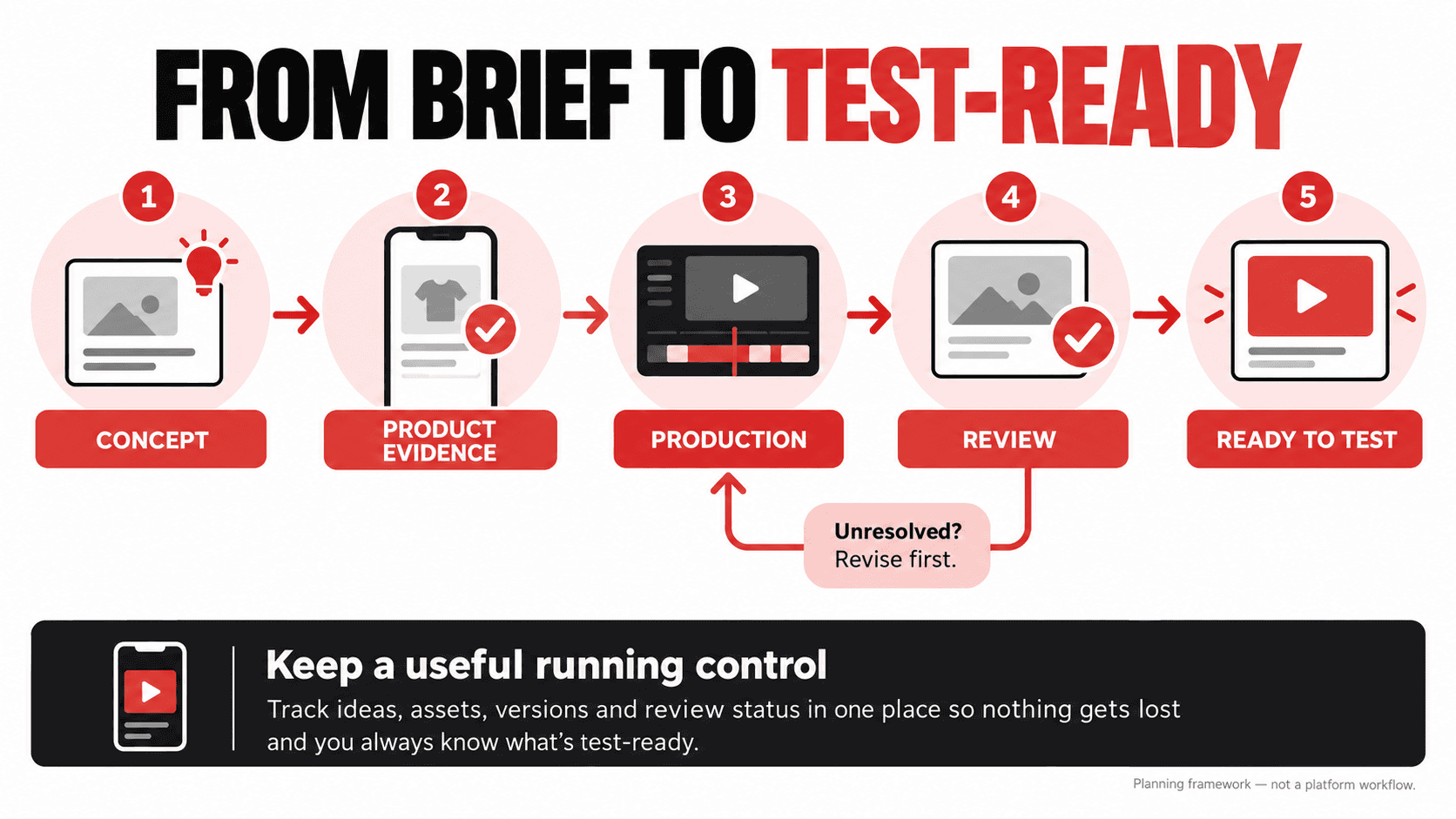
For each item in the production queue, record:
- The audience problem or question it addresses.
- The product promise and evidence supporting it.
- The meaningful difference from existing creative.
- The required app footage, permissions, or disclosures.
- Its current production stage and owner.
- The decision the eventual test should inform.
Reserve “production-ready” for an asset whose footage matches the current app experience, whose claims and disclosures have completed the advertiser's review, and whose file meets the intended placement's format requirements. Check that its destination opens the intended app-store page or app experience and matches the promise in the ad. Record any outstanding dependency; a finished script or export alone is not a ready asset. Production-ready is not launch-ready: allow separately for TikTok ad review and any revisions or resubmission before delivery can begin. Internal checks do not guarantee platform approval.
Learn from creative history without inventing a decay curve
Historical results can help estimate demand for fresh work. They cannot automatically tell you how long the next ad will last.
Build a simple record of when each asset began meaningful delivery, when a concern emerged, what happened next, and why it eventually stopped. Keep age alongside delivered exposure and campaign context.
Separate assets stopped for weak results from those stopped because an offer ended, a budget changed, or another test took priority. Keep assets still running visible rather than treating them as completed lifetimes.
Otherwise, the average “days until retirement” can describe the team’s operating habits more than audience fatigue.
Use this history to answer practical questions:
- Which kinds of updates were repeatedly needed?
- Where did production fall behind a campaign decision?
- Which challengers were ready but never received a useful test?
- How often did a replacement improve the business outcome?
- Which concepts continued working longer than the team expected?
If the evidence is sparse, say so. A provisional capacity plan is more honest than a precise-looking decay forecast built from a handful of uneven tests.
Build the buffer around actual production lead times
Measure elapsed time from brief to launch-ready, not just editing time. Include product clarification, accurate app recordings, permissions, claims review and revisions, then platform ad review and any resubmission. Track production and platform-review time separately so an approved export is not mistaken for an ad ready to deliver.
Compare that lead time with the response window the account can afford when a performance concern appears. Historical reviews can help estimate that window, but they are not a guarantee or permission to continue poor spending. Set the window against the current budget boundary, outcome maturity, and risk. If production takes longer, brief a challenger before a concern appears, not after.
When history is sparse or conditions have changed, treat the window as uncertain and plan a conservative fallback. An inaccurate claim or outdated offer requires immediate action; never keep it running while a replacement is produced.
Identify the actual asset available during that gap and its remaining dependencies. A concept tied to an unreleased feature is a weaker fallback than a reviewed demonstration of an existing one. “The team can turn something around” is not a reliable buffer.
Before adding more variations, ask whether the account has the budget and outcome volume to evaluate them alongside the work already running. For a small account, one differentiated challenger may be more useful than a large untestable batch. A larger account may need coverage across markets, languages, or propositions. Prioritize the question most likely to affect the next acquisition decision, rather than adopting a universal asset quota.
Give each ready asset a test handoff
A production handoff should contain more than a video file and the instruction to launch it.
Before launch, record the question, the control, the comparison method, the primary outcome and when it matures. Define what counts as a win, a loss, or an inconclusive result before seeing the data: the improvement that would justify a change, the quality guardrails that must hold, and the evidence needed to make that judgment. For an app advertiser, the primary outcome might be cost per activated user or a later revenue measure, rather than clicks alone.
Where suitable and available, TikTok’s split-testing feature separates audiences into equal groups that see different ad groups while holding other variables constant. Its supported test variables include creative. An ordinary before-and-after comparison does not provide the same control; label it as weaker evidence and record competing explanations. TikTok’s split-testing documentation
Specify when the downstream result will be mature enough to interpret. A newly acquired cohort cannot supply a completed D30 result. If the campaign needs an earlier decision, identify the earlier signal and acknowledge what remains unknown.
Set a spending boundary and immediate stopping conditions. Decide what happens if the result is inconclusive: retain a still-qualified control, retest a sharper difference within an agreed budget, or drop the question. Reaching the spending boundary without an answer is not evidence of a winner.
Keep a change log with the handoff. Record creative introductions alongside material changes to budgets, targeting, optimization, destinations, and app experience so the result can be read in context.
TikTok notes that performance can fluctuate during learning, and that pauses or edits that retrigger learning can affect the process. This is a reason to make deliberate changes and interpret early results carefully, rather than a guarantee that waiting will rescue an ineffective asset. TikTok’s learning-phase guidance
Make the production review useful to the advertiser
A concise review can connect four things: what is running, what the evidence suggests, what is ready, and what the business must supply next.
Consider a hypothetical utility-app campaign. The existing demonstration remains within its agreed performance range. A challenger addresses a different user objection, but its recording shows a feature that has changed. It is not ready to test.
The advertiser's product owner confirms the current flow; the creative producer replaces the recording and completes the internal checks. The campaign lead accounts for platform review, then owns the comparison against the existing demonstration.
Here is a filled-in handoff for that hypothetical test. These choices illustrate the format, not recommended thresholds or a universal timetable:
- Outcome: activation means completing a first task within seven days of install; compare cost per activated user in a creative split test where available.
- Readout: evaluate 14 days after the last test install. This example allows time for the seven-day outcome and reporting delay; another app may need a different window.
- Decision: seek at least 15% lower cost per activated user, with D7 retention no worse than the control. The predeclared analysis uses 95% confidence intervals: the cost improvement interval must support at least 15%, and the retention-difference interval must rule out a decline. A 15% point estimate alone does not qualify.
- Budget and fallback: stop at the fixed budget agreed before launch. If the available data cannot establish those conditions, do not promote the challenger on this test; retain the qualified control and record what remains unanswered.
The example deliberately separates the business target from the uncertainty test. An attractive estimate is not proof, and a budget-limited result may remain inconclusive.
The calendar organizes production. Account evidence determines the change.