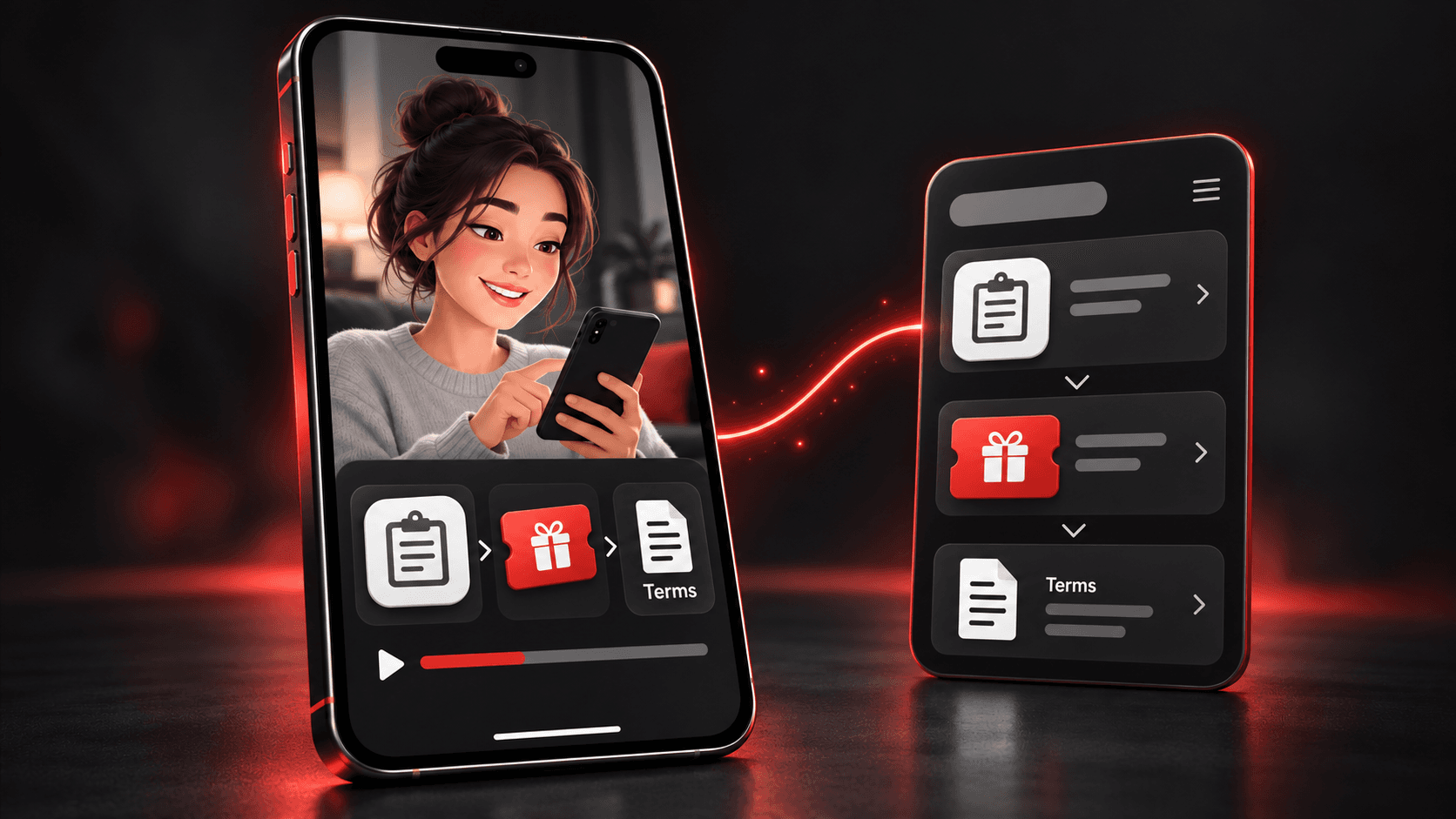
Getting a rewards app ad ready for TikTok starts with a simple question: can the person who taps it actually receive the experience the ad promises?
That question reaches beyond the headline. A video can imply effortless income through its balance animation, editing, voiceover, or withdrawal screen even when the caption is carefully worded. An accurate ad can also fail if the product is restricted in the target market or the destination leaves out an important condition.
For app businesses and their paid-social partners, the useful approach is to establish eligibility, make the reward mechanism understandable, and carry the same promise through the customer journey. This guide draws on TikTok's published policies checked on October 19, 2026. The practical examples are editorial recommendations, not pre-approved copy or a guarantee of approval.
Check the product and market before writing the hook
“Rewards app” describes a benefit, not a single policy category. A survey app, a cashback service, and a skill-based game with cash prizes can have different mechanics and different advertising requirements.
This distinction matters in the current rules. TikTok's Gambling and Games policy, updated in August 2026, explicitly includes rewarded gaming within non-casino games. Its definition covers skill-based games offering real-money rewards based on participant performance rather than chance. The policy also describes certification, geographic restrictions, and age requirements for gambling services, with market-specific conditions. Read TikTok's Gambling and Games policy.
That definition does not establish that every app offering points or cashback is a gambling product. It does mean that an advertiser should check what the app actually does before assuming it is an unrestricted utility. Ask the app business to document how users qualify, whether payment or chance is involved, what has real-world value, and where the offer is available. Resolve uncertain classification with TikTok before production and spend.
If the product includes financial services, check that policy separately. TikTok lists get-rich-quick offers among prohibited examples and applies licensing, disclosure, and age conditions that vary by market. A rewards label does not settle whether a financial-service feature is eligible. Read TikTok's Financial Services policy.
Explain the activity behind the reward
An advertiser should be able to explain the exchange in ordinary language. What does the user do? What counts as a qualifying action? What do they receive, and when can they redeem it?
TikTok's Deceptive Practices policy identifies missing explanations of financial outcomes, exaggerated financial gains, money-flaunting, and guaranteed wins as problem areas. It also prohibits deceptive claims and omitted fees or charges. Read TikTok's Deceptive Practices policy.
Build the creative brief from a short, app-owner-verified fact sheet:
- The qualifying activity, including any purchase, time commitment, or completion requirement
- The reward type: points, a discount, a gift card, or money, without treating those as interchangeable
- Eligibility and availability, including location, age, and any screening or offer limits
- Redemption thresholds, processing steps, waiting periods, and relevant fees
- The support route when a qualifying action is not recorded or a reward is delayed
This is our recommended preparation checklist, not a list of fields TikTok requires in every ad. Its purpose is to expose gaps before a creative team turns an incomplete description into a confident promise. The app business supplies the product facts; the growth partner can check whether the advertising represents them faithfully.
Write a claim that the evidence can support
TikTok prohibits misleading or exaggerated product-result claims and inconsistent promotion details between an ad and its destination, including missing terms. Read TikTok's Misleading and False Content policy.
For a rewards advertiser, our practical recommendation is to describe a real activity and its conditions before reaching for an income headline. Consider these fictional examples:
- “Get paid just for opening the app” would be unsuitable if payment requires qualifying activity. A more accurate starting point could be “Explore available surveys and see the reward before you start,” but only if the app actually works that way.
- “Instant cash out” would be unsuitable if it implies immediate access to money while undisclosed thresholds, verification steps, or processing delays prevent that. Describe the real redemption process and show the relevant conditions instead.
- “Everyone earns” would be unsuitable if users can fail screening or offers vary. Explain the specific eligibility limitation where it matters to the offer.
These are ways to make the proposition more accurate, not phrases that unlock approval. Adding “up to,” “results vary,” or a tiny disclaimer does not answer whether the main impression is fair. If an amount is central to the ad, the app business needs evidence for that amount and for the circumstances in which a user can receive it. One exceptional outcome is a poor foundation for an everyday expectation.
Let the visuals demonstrate the same experience
A useful rewards-app video can show a person opening an available task, checking its conditions, and finding the redemption information. That gives the viewer something concrete to understand without implying a payout that the product cannot reliably deliver.
Review the edit as a sequence. Does a jump cut collapse several days of activity into an apparently immediate result? Does a balance animation suggest money is already withdrawable when it is still pending? Does a creator's first-person line describe an experience they actually had? These are editorial checks we recommend before approving an asset.
TikTok also prohibits misleading interactive elements, such as fake controls, and requires disclosure for significantly edited or AI-generated advertising content. A disclosure does not make an invented payout or false endorsement acceptable. See its rules for clickbait and edited media.
Use current, authorized product footage wherever possible. If a demonstration uses a test account or illustrative screen, make its nature clear and avoid presenting a fabricated balance as proof of earnings. Keep personal account details out of the creative. TikTok's review checklist also calls for the necessary rights to brands and copyrighted media, alongside suitable media quality and supported interactions. Read the ad-review checklist.
Carry the promise through the click
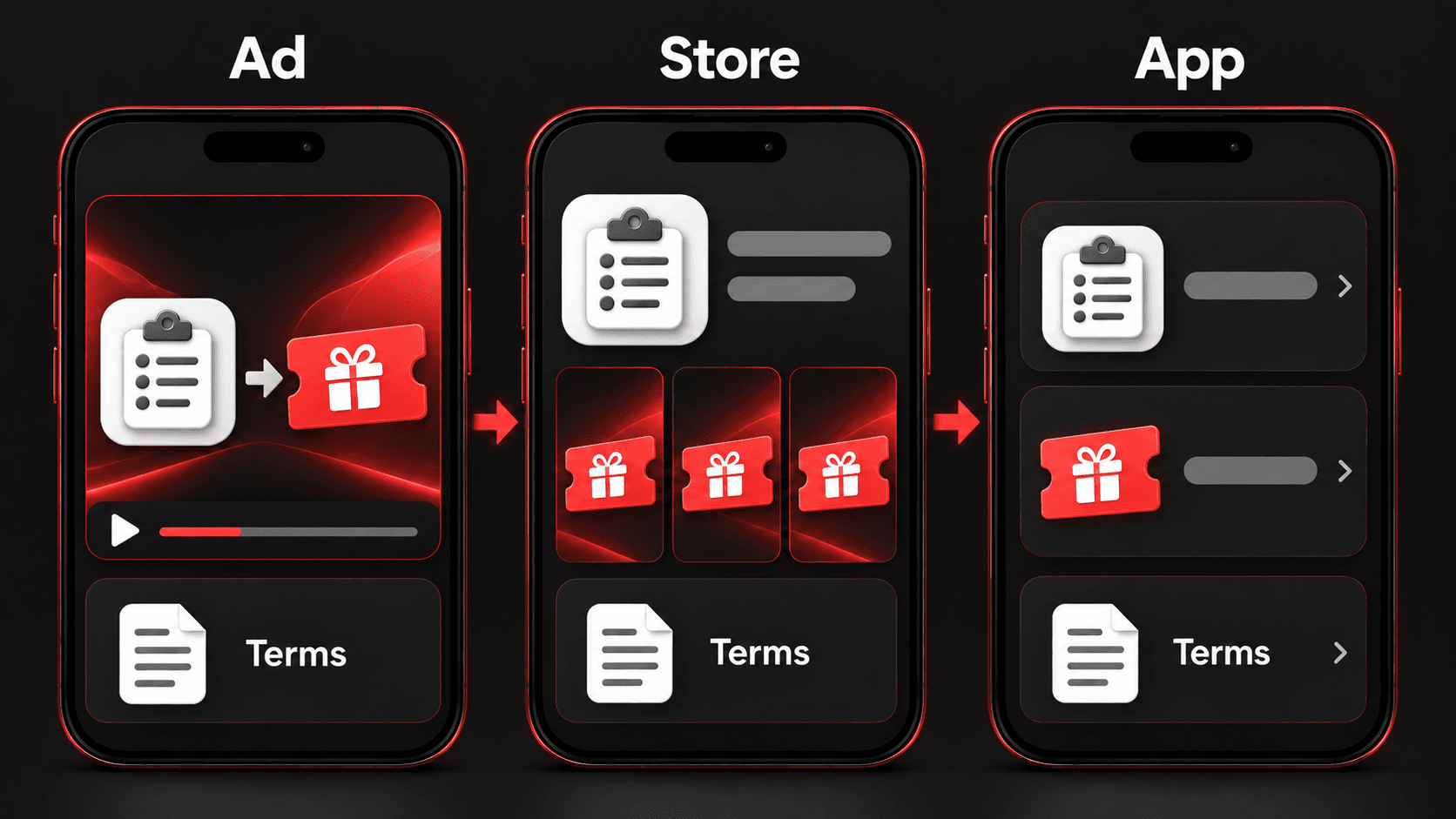
The handoff from ad to destination deserves its own review. TikTok's format and functionality rules require working landing pages and consistency across the creative, caption, call to action, app name, and promoted product. Language and currency also need to fit the target market. Read the format and functionality policy.
Our recommended check is to follow the actual route on the intended device: ad, any intermediate page, app-store listing, and first relevant in-app screen. Record what the person learns about the offer at each step. If the ad highlights a specific reward, can someone find that offer and its conditions after tapping? If the reward is unavailable in that country or app version, the team needs to resolve the mismatch before launch.
Check the presentation on a phone rather than assuming a desktop review is enough. Important conditions should be readable without detective work. TikTok's landing-page guidance specifically calls for mobile-friendly pages, readable text, and restrictions on requiring sensitive information merely to access the site. Read the landing-page checklist.
The growth partner may not control the store listing, product rules, or onboarding. Agree who owns each correction. A clear issue with a named owner is more useful than repeatedly rewriting an ad around an unresolved product gap.
Give the reviewer a complete, consistent version
Before submission, keep one approval packet containing the final video and caption, destination links, the product fact sheet, supporting evidence for material claims, and any relevant permissions or industry documents. Record the target market and app version. This is an internal working practice, not a claim that TikTok requires that exact packet.
Have someone outside the edit review the package as a prospective user. Ask them what they think they must do to receive the reward, whether they expect everyone to qualify, and when they expect to redeem it. Compare their answers with the product facts. A misunderstanding discovered here is still inexpensive to fix.
Keep the approved version identifiable. Changing a voiceover, adding a dramatic opening, or swapping a destination can change the meaning even when the campaign name stays the same. The person submitting the ad should know which version the app business has checked.
If it is rejected, address the stated reason
Separate a product-eligibility problem from a creative or destination problem. A classification issue may need product documentation. A misleading claim may need a substantive rewrite. A broken page needs a working page. Cosmetic changes cannot resolve every rejection.
If the decision appears mistaken, TikTok's One Click Appeal process lets advertisers supply a reason and supporting materials. Its current guidance says to file one appeal per incident, warns that duplicates can delay processing, and says an ad or ad group cannot be edited after that appeal is submitted. The entire ad group is re-reviewed even when the appeal starts at ad level. Read the current appeal instructions.
Make the explanation specific: identify the rejected claim or screen, explain the real product behavior, and point to the evidence that addresses the reason. Provide only what is needed through the authorized support process; avoid unrelated customer records or unredacted personal financial details.
Do not disguise the same offer, switch identities, or show reviewers a different destination to escape scrutiny. TikTok's Advertiser Account Policy prohibits circumventing its advertising systems and moderation procedures. Read the account policy.
Treat approval as the start of the customer promise
An approved ad still needs to attract people who understand the offer. A campaign that buys installs from users expecting effortless income can leave the app business with disappointment, support costs, and weak retention even when the clicks are genuine.
TikTok's after-conversion guidance emphasizes accurate product expectations, transparent app costs, eligibility, and limitations. It also considers negative customer feedback in enforcement. Read its after-conversion experience guidance.
For a client review, we recommend examining the quality of the resulting journey alongside acquisition cost: legitimate qualifying activity, reward-related complaints, redemption friction, and continued use. Agree the definitions with the app business and use appropriately aggregated reporting. A lower CPI cannot tell you whether people understood what they were signing up for.
The strongest preparation connects three things: an eligible product, an evidence-backed ad, and an experience that keeps its promise. That gives the app business and its growth partner a sound basis for submission, a clearer response if review goes wrong, and a more useful campaign to evaluate once it runs.